
Linux Foundation Newsletter: August 2026
12 Aug 2026, 9:05 pm.png)
Welcome to the August 2026 edition of the Linux Foundation Newsletter
The Linux Foundation is celebrating 35 years of Linux, and training is discounted through August 18. Use code TUX35 for 35% off certifications, courses, and bundles across cloud, AI, cybersecurity, and more.
Beyond the discount, five things stand out this month. The Linux Foundation launched the Tokenomics Foundation, backed by more than 30 organizations, to build vendor-neutral standards for tracking the cost and ROI of AI. FINOS released Fluxnova 3.0 and FDC3 3.0, both adding MCP integration so AI agents can execute financial workflows directly. AAIF shipped MCP 728, a stateless version of the protocol that no longer needs a session handshake, and celebrated the launch with 475 people across 7 events in 6 cities. The Dronecode Foundation ran a hackathon in Manassas, Virginia, where 14 companies, including direct competitors, completed 7 working integrations of MAVLink-Military, a new open interoperability standard for military drones and payloads. And a wave of AI-and-infrastructure research landed at once: a CNCF and SlashData report puts Japan's cloud native developer community at nearly a million, LF Edge published its State of the Edge 2026 report on edge computing in the AI era, and a new tech talent report shows AI is a net job creator in Japan even as companies struggle to find full-stack-ready hires.
You'll also find open calls for two LF Research surveys, a new LF Research report, registration open for Open Source Summit Europe in Prague (October 7-9), and project news spanning agentic AI, telecom, mainframe, geospatial, and safety-critical software.
>> Read on for even more news, research, and opportunities from across the Linux Foundation.

Proposing the SAFE Working Group: An Open Community Effort to Improve AI Security
4 Aug 2026, 1:00 pm
The open source community has shown time and again that collaboration produces better software, stronger security, and more resilient infrastructure. As AI becomes increasingly integrated into enterprise applications, developer workflows, and critical infrastructure, we have an opportunity to apply those same principles to one of the industry's newest challenges: learning from AI security incidents.

From Campus to Community Part 4: How Academia Plugs In
28 Jul 2026, 1:37 pm
This is a series from Linux Foundation Board Chair, Nithya Ruff. Read Part One, Part Two and Part Three.

Open Models and Open Weights Are Foundational to Secure AI
27 Jul 2026, 1:24 pm
The Linux Foundation celebrates collaborative efforts to build and enhance the open tools and techniques that keep AI systems safe and secure.

From Campus to Community Part 3: What Universities Uniquely Bring
21 Jul 2026, 2:14 pm
This is a series from Linux Foundation Board Chair, Nithya Ruff. Read Part One and Two.

Linux Foundation Newsletter: July 2026
15 Jul 2026, 9:09 pm
Welcome to the July 2026 edition of the Linux Foundation Newsletter
July is one of the best months for LF Training deals. For 2026, the "Finish the Year Strong" promotion brings savings of up to 40% on vendor-neutral training, certifications, and bundles across Linux, cloud native, cybersecurity, AI, and more. The offer ends July 21. Don't miss it.
Beyond education, this month's newsletter highlights open source communities converging in person and in production. KubeCon + CloudNativeCon Japan lands in Yokohama July 28-30, the Academy Software Foundation brings Open Source Days back to SIGGRAPH, and following the launch of Akrites, FINOS and seven major financial institutions announced their intent to form OSERA, mutualizing security remediation for the packages regulated industries depend on. You'll find three active LF Research surveys and two new reports, fresh perspectives from Linux Foundation Europe, featured project news spanning agentic AI, telecom APIs, mainframe, geospatial, and safety-critical software, and a busy global events calendar. Feedback is welcome.
>> Read on for even more news, research, and opportunities from across the Linux Foundation.

What Agentic AI Asks of Open Source Strategy: A New Layer for OSPOs
15 Jul 2026, 2:30 pm
Open Source Program Offices (OSPOs) have spent years helping organizations make sense of the open source they depend on: licenses, dependencies, security, standards, and the ecosystem engagements and partnerships behind the software they use strategically.

From Campus to Community Part Two: The Researcher Exodus
13 Jul 2026, 2:07 pm
This is a series from Linux Foundation Board Chair, Nithya Ruff. Part One can be found here.

From Campus to Community Part One: The Critical Symbiotic Relationship Between Academia and the Linux Foundation
7 Jul 2026, 4:17 pm
This is the first in a four-part series on open source and academia from Linux Foundation board chair, Nithya Ruff.
I was fortunate enough to recently give a speech at the University of California at Berkeley on the role and importance of academia in the rise of open source software. The setting could not have been more relevant. Perhaps more than any other academic institution, Berkeley has birthed critical open source projects and technologies. Berkeley Software Distribution (BSD) was the precursor to FreeBSD and multiple other open source operating systems. BSD’s networking stack, TCP/IP, became the open source core of the Internet. The open source RISC-V semiconductor instruction set, the Apache Spark data analytics engine, and the Ray distributed AI orchestration system all emerged from Berkely.

Measuring OSPO Value
29 Jun 2026, 9:17 pm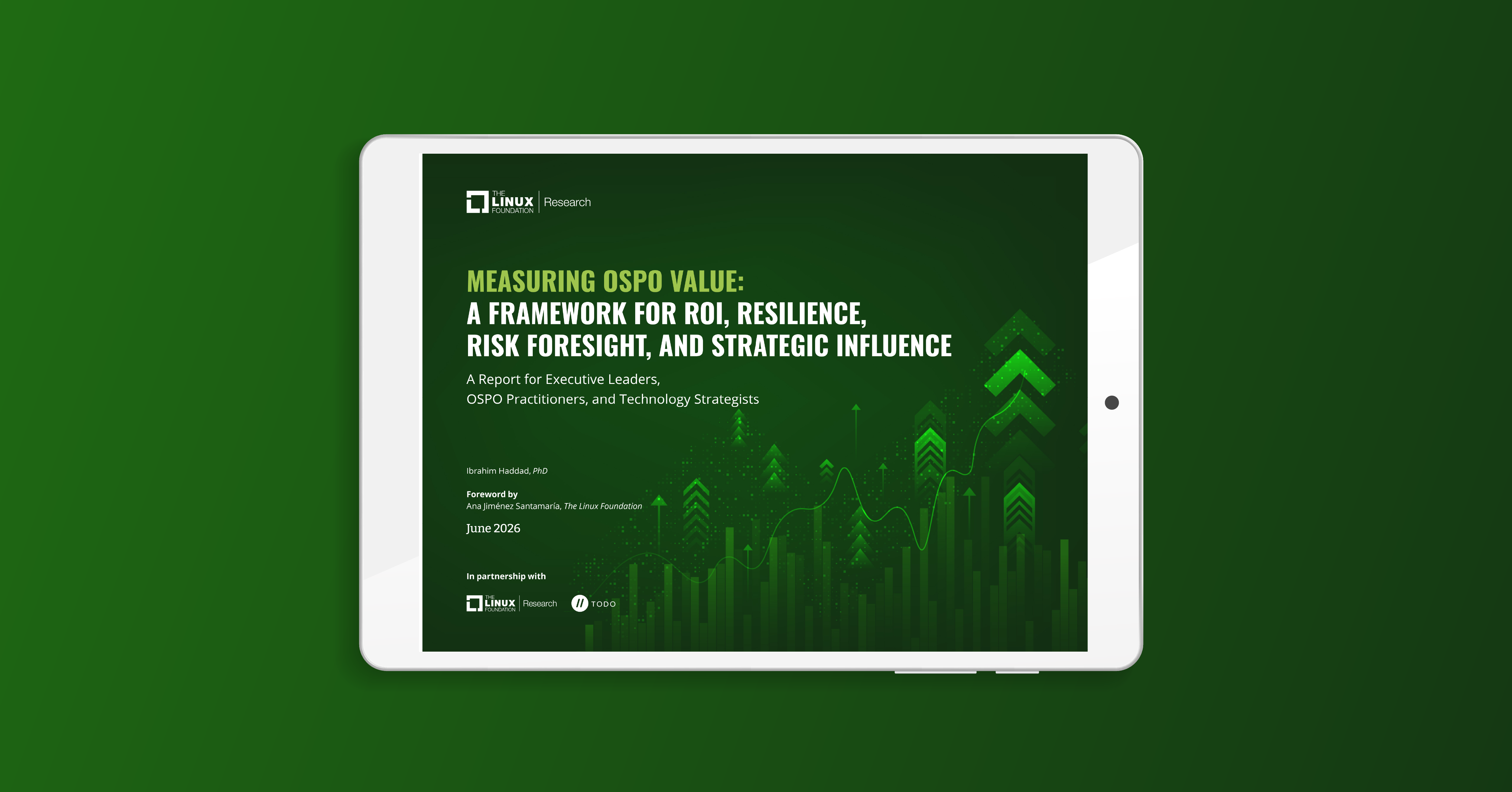
Open Source Program Offices (OSPOs) play important roles within organizations, but that role isn’t always appreciated or understood within the executive team or by other stakeholders. In the current financial climate, some OSPOs have been the targets of cutbacks and layoffs, so this is a particularly important time for OSPOs to be clear about the value that they provide to their organization. Leaders within every organization are responsible for making sure that their organization focuses on the activities that have the biggest impact on helping that organization achieve their goals. As a result, OSPOs need to be able to demonstrate that the value of their work can have a larger impact on the organization than the other initiatives that are also competing for resources. As the CHAOSS OSPO Metrics Working Group co-chair and CHAOSS board member, the topic of measuring OSPO value is one that I have cared deeply about for years, and I recently gave a talk on this topic at the Open Source Summit North America in May. This is why I was so excited to read Ibrahim Haddad’s latest report, Measuring OSPO Value: A Framework for ROI, Resilience, Risk Foresight, and Strategic Influence, and share a few highlights from the report in this blog post.
