
Spreadprivacy.com is the official blog of DuckDuckGo, focusing on privacy education, news, and tips, while emphasizing anonymous searching and robust online privacy tools.
Google Built a Monopoly on Search Defaults and Will Do It Again in AI
5 Aug 2026, 2:53 pm
This week, DuckDuckGo is filing an amicus brief in the appeal of a federal court decision that Google unlawfully maintained a monopoly in the general search market in violation of the Sherman Antitrust Act. Google is asking the appeals court to throw that decision out, while the U.S. Department of Justice is asking for stronger remedies. DuckDuckGo’s brief shares our own experience and explains how Google shut out competition. More importantly, we describe how Google’s actions harmed not just competition but also undermined people’s ability to protect their privacy.
DuckDuckGo has spent nearly two decades building a differentiated search engine. It doesn’t track you; it doesn’t profile you; and it does protect your privacy. Nevertheless, many privacy-focused users continue to use Google for the sole reason that they use a device or browser that is contractually obligated to have Google preset as the default search engine.
Two years ago, a federal court finally agreed. That ruling should be upheld.
The record reveals the depths of Google’s monopoly
This trial established one simple fact: for most people, the competition for their search traffic is over before it begins. Google is the default search engine on roughly 70% of U.S. search access points, and the district court understood that being the out-of-the-box default is the most efficient way to distribute a search engine. Google doesn’t dispute this; it can’t.
Defaults win because people rarely change them. Most searches happen out of habit, and many people don't know there is a default, what it is, or that it can be changed. Completely ditching Google across a phone, tablet, and laptop requires detailed tutorials and hours of effort. Even DuckDuckGo's most devoted users, the ones who recommend us to friends, admit they haven't changed all their defaults. That’s not real consumer choice; it is a maze.
Google doesn’t compete; it obstructs
Google understood the power of defaults perfectly, and it spent enormous effort making sure no one could escape them.
First, it froze the search ecosystem with money, and lots of it. Google paid out billions of dollars, which was far more money than any rival could hope to match. As the Justice Department argues, those payments “made it economically irrational for distributors to switch default [search engines], thereby inducing exclusivity.” The district court agreed, finding it “financially infeasible” for Google's partners to switch away or seek greater flexibility. Time and again, browsers, device makers, and phone carriers concluded they couldn't afford to leave. So they didn’t.
Second, Google introduced choice friction to stymy users. Evidence was presented that Google tracks how many steps it takes to change defaults on different devices; it also discouraged Android manufacturers from giving users too much information about how to switch. While there is no technological reason a person shouldn’t be able to change their search engine in a single click, Google has ensured there’s no easy way to do just that.
This isn't a company that outcompeted its rivals. It simply paid to push everyone else out.
Google is running the same playbook in AI
Google is now doing to AI what it did to search. While the district court expressed hope that competition from generative AI might discipline Google and disrupt the market on its own, there is scant evidence of this.
Instead, it is pushing its own product through the platforms it already controls, whether people want it or not. It has wired its Gemini AI assistant directly into Chrome and moved to preload Gemini across the Android ecosystem, positioning it as the default AI assistant on the very devices at issue in this case. Capture the default, get in front of users before any rival can reach them, and turn placement into habit before anyone knows better.
What makes this so telling is that Google has forced AI on its users even when the product plainly wasn't ready. In May 2024, Google switched on AI for everyone, and it promptly started pulling “facts” from satire and troll posts. There was no easy way to turn it off. Google can shrug off a faillure like this in a way rivals cannot, using the profits from its search monopoly, to try and try again.
More than 95% of Americans still use a conventional search engine every month, a figure that barely moved despite AI-tool usage nearly quintupled. Nine in ten search referrals continue to come from Google, even including new generative AI rivals. That is what a monopoly looks like.
Affirm Google’s monopoly and end it
It doesn’t matter if people don’t want AI. It doesn’t matter if Google’s AI is wrong. Google can't be fired. No matter how badly the product performs, people stay put, because Google controls every access point where people want to search for information. That is the story of the search market and what may await AI, and it is why the court’s finding that this conduct is illegal monopolization must be upheld.
Google broke the law. It's paid no price. Congress can change that.
17 Jul 2026, 6:50 am
Nearly two years ago, a federal court ruled that Google illegally monopolized search. The judge was specific about how: Google didn't win by building a better product. It paid billions of dollars to be the default everywhere, on your phone and in your web browser, such that most Americans never actively choose their search engine at all.
That ruling should have been a turning point. Instead, nothing has changed.
Getting away with a monopoly.
The court's decision was a diagnosis, not the cure. The remedies ordered last year fall dramatically short of what needs to happen to level the playing field in search. And Google has appealed them anyway. So too has the Justice Department, seeking the stronger fixes it originally asked for. The strongest remedies haven't taken effect and may not for years to come. Meanwhile, the court-appointed technical committee charged with putting change into practice is only just getting up and running. The result is a company operating exactly as it did before being declared a monopolist while running the same exact playbook that was ruled to be illegal. This is the definition of getting away with it.
And the harm compounds each day. Google's vice grip on search was never only about defaults. It rests on two engines. The first is distribution, or the paid defaults that the court condemned. The second, less visible, is scale. Because Google sees far more searches than anyone else, it trains its systems on data no rival can touch. At trial, an analysis of 3.7 million unique search phrases over a single week found that 93% were seen only by Google. More searches produce better results, which draw more users, which produce still more searches. Every day the remedies are delayed, that flywheel spins faster and the gap a court has already ruled illegal grows wider. And the same flywheel is now spinning up in AI, threatening to rig the next era of search before it starts.
Congress doesn't have to wait.
It doesn't have to be this way. A solution now exists in Congress. Introduced this week by Senator Klobuchar and Senator Schmitt, the SEARCH Act – Securing Enforcement of Americans' Right to Competition at Home – would end Google's waiting games. It also directly addresses both of Google's engines of monopoly at the same time.
On distribution, Google could no longer pay to be the preset default, nor wire its own search into Chrome and Android instead of letting you choose. People would choose for themselves and could switch in a single step, including straight from a competitor's own website or app.
Scale is the harder problem, and the SEARCH Act proposes to do the thing that actually closes the gap. Google would have to share search results and de-identified data with rivals. This would let new startups, AI companies and existing search engines compete on a level playing field for your loyalty on privacy, design, and overall experience.
This bipartisan proposal would codify the same package of remedies that the Department of Justice and a coalition of 49 states and territories fought for in court, and its rules would apply to AI as well as search. DuckDuckGo is proud to support the SEARCH Act. We urge Congress to pass it without delay.
Endorsements and additional information
The text of S. 5007 is available to read here. The SEARCH Act is endorsed by the Bull Moose Project, Digital Progress Institute, and Public Knowledge.
Statements of support:
In U.S. v. Google, the court found Google had illegally used its search monopoly to lock out search defaults from competitors, preventing them from operating at the scale needed to be optimally competitive. The SEARCH Act proposes to finally do something to fix this broken search market. DuckDuckGo is grateful to Senator Klobuchar and Senator Schmitt for their leadership on this bill and for taking on a fight that's long overdue. This is what a serious, bipartisan fix looks like, and we're proud to support it.
— Gabriel Weinberg, Founder and CEO, DuckDuckGo
The courts have done what they can with the tools they have, and it isn't enough. Even after a federal judge found that Google unlawfully monopolizes the search market, the remedies that followed relied on behavioral fixes rather than the kind of structural relief that actually restores competition, proving that antitrust law as written wasn't built for markets like this one. Congress can't keep leaving it to judges to improvise solutions case by case; lawmakers need to give the courts clear, modern guidance for dealing with dominant digital platforms, and DPI urges Congress to pass the SEARCH Act.
— Joel Thayer, President, Digital Progress Institute
Google's motto used to be, "Don't be evil." They dumped that years ago, instead choosing to eliminate competition through self-preferencing and exclusivity agreements. Using their browser, Google Chrome, and their search engine - the main venue through which millions ofAmericans find information - Google picked winners and losers while also giving preference to themselves, including their AI, Gemini.
The SEARCH Act will hold Google and other future monopolists accountable by building upon the proposed remedies from U.S. v. Google, opening up search, advertising, and even internet browsers as areas of competition and innovation instead of control by one behemoth. We commend Senators Schmitt and Klobuchar for introducing this bill, and encourage quick and speedy passage.
— Aiden Buzzetti, Founder and President, Bull Moose Project
The Google search case shows why antitrust enforcement and legislation must work together. Courts must stop unlawful conduct and restore competition in the market Google monopolized. Google’s effort to overturn the remedies should fail, and the states are right to seek stronger relief. But litigation takes years, often after monopoly power has become deeply entrenched. The SEARCH Act would establish clear, forward-looking rules for the largest search platforms, including restrictions on payments for preferential treatment and exclusive distribution arrangements. Antitrust remedies can reopen the search market. The SEARCH Act can help keep it open.
— Patrick Gallaher, Senior Policy Advocate, Public Knowledge
Watch YouTube Without Ads on the DuckDuckGo Browser
8 Jul 2026, 11:23 am- DuckDuckGo now blocks most video ads! Use our free browser to get the full YouTube experience, minus the ads.
- YouTube Ad Blocking joins our powerful lineup of browsing protections that manage cookie pop-ups, protect you from invasive tracker-based web ads, and more.
- YouTube Ad Blocking is already on by default for most iPhone, Windows, and Mac users! It will be auto-enabled for Android soon, but users can opt in via browser Settings in the meantime.
Interruption-free YouTube with DuckDuckGo
Tired of ads interrupting your videos? Us, too. The DuckDuckGo browser now blocks most video ads, including on YouTube! This new feature blocks ads that run before and during your videos, letting you watch YouTube without the interruptions.
If you’ve been here a while, you already know that the DuckDuckGo browser also protects you from invasive ads and annoying pop-ups on multiple fronts. We block tracker-powered web ads before they can load. We have Global Privacy Control enabled by default, expressing your opt-out rights by telling websites not to sell or share your personal information. We can even manage cookie pop-ups behind the scenes, so you don’t have to deal with the distraction.
How do I access YouTube Ad Blocking?
YouTube Ad Blocking is on by default for iOS, Windows, and Mac. So, there’s no need to adjust your settings, if your app is up to date; just open the browser and start enjoying ad-free videos! The feature will be on by default for Android soon, but in the meantime, turn it on in your browser’s Settings > Ad Blocking. If you don’t see YouTube Ad Blocking on your device, try updating your app.
On all devices, you can disable or re-enable YouTube Ad Blocking any time from your browser’s Settings > Ad Blocking. You can also turn it on and off while you’re watching a video. On desktop, click the video icon next to the green shield in your address bar. On mobile, tap ☰ > Disable YouTube Ad Blocking.
When you disable ad blocking mid-video, the browser will prompt you to send an error report, alerting us to any problems. This is completely optional, anonymous, and helps us make our product better…so we appreciate it!
Please note: if you’re on a mobile device, links to YouTube videos may open in the YouTube app by default. To enjoy DuckDuckGo’s YouTube Ad Blocking, you need to open the YouTube website in the DuckDuckGo browser. It won’t work in the YouTube app.
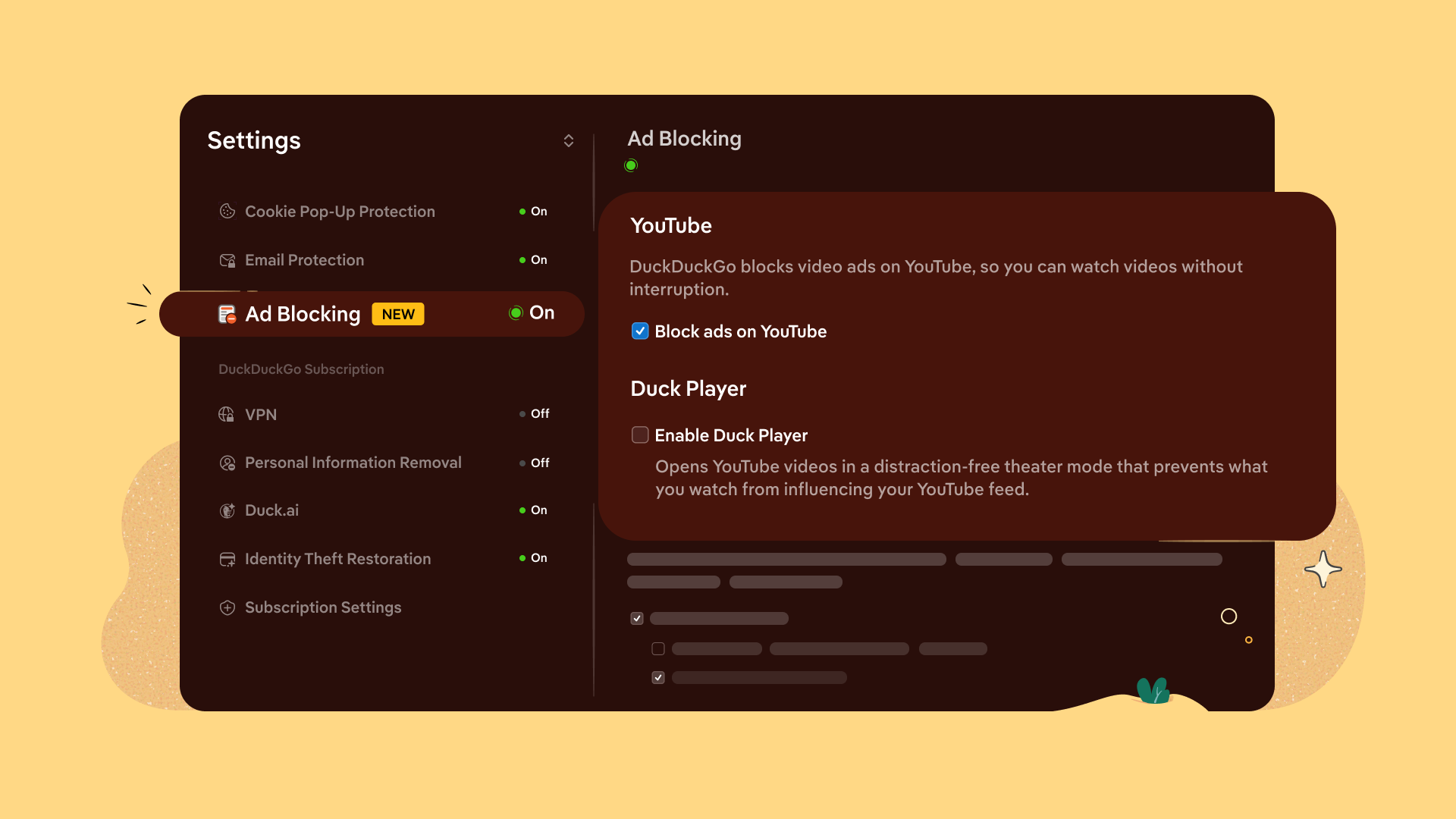
Manage your YouTube Ad Blocking and Duck Player preferences from browser Settings.
Is YouTube Ad Blocking different from Duck Player?
Yes, they’re different – but complementary!
Duck Player is the browser’s built-in video player that lets you watch YouTube videos in a distraction-free theater mode. It also protects you from tracking cookies and personalized ads by enforcing YouTube’s strictest privacy settings for embedded video. This means what you watch in Duck Player won't influence your YouTube recommendations. (It also won’t save your place in playlists.) Opt in to Duck Player and adjust your preferences from your browser Settings > Ad Blocking.
YouTube Ad Blocking blocks video ads on the YouTube website, so you can watch without interruption. It's the regular YouTube experience, just without ads. So you’re free to take advantage of YouTube features like remembering your viewing history and saving your spot in playlists.
You don’t have to pick just one: you can have YouTube Ad Blocking and Duck Player enabled at the same time.
How does YouTube Ad Blocking work?
To detect and block YouTube ads, we use community-driven filter lists sourced from uBlock Origin. These lists are maintained by an active open-source community and are regularly updated to keep up with changes to how ads are served. We may also apply our own rules to improve compatibility and reduce breakage. As with most ad blockers, using our ad blocker can lead to some additional buffering times. But once your video loads, you won't be interrupted with ads.
Let us know what you think!
YouTube Ad Blocking is available now in the DuckDuckGo browser. It’s still a new feature, so give it a try and let us know how it’s working for you! Send anonymous feedback any time from your browser’s ☰ menu.
DuckDuckGo's New Pro Plan: 2x AI Limits, More Advanced Models
18 Mar 2026, 1:29 pm- The DuckDuckGo subscription includes our VPN, access to more advanced private AI when you want it, Personal Information Removal, and Identity Theft Restoration. It now comes in two plans: Plus, which includes all four protections, and Pro, which unlocks even more powerful AI functionality.
- The new Pro plan is for people who use AI for demanding tasks. On top of the VPN and other protections, it includes three Duck.ai upgrades: 2x higher usage limits than Plus, exclusive access to Claude Opus 4.6, and the highest reasoning available on Duck.ai. (Extended reasoning capabilities available on GPT-5.2 and Claude Opus 4.6.)
- Whether or not you’re a paid subscriber, everyone gets the same industry-leading privacy protections when you search and browse with DuckDuckGo, or chat privately with ChatGPT, Claude, and other popular AIs on Duck.ai.
What is the DuckDuckGo subscription?
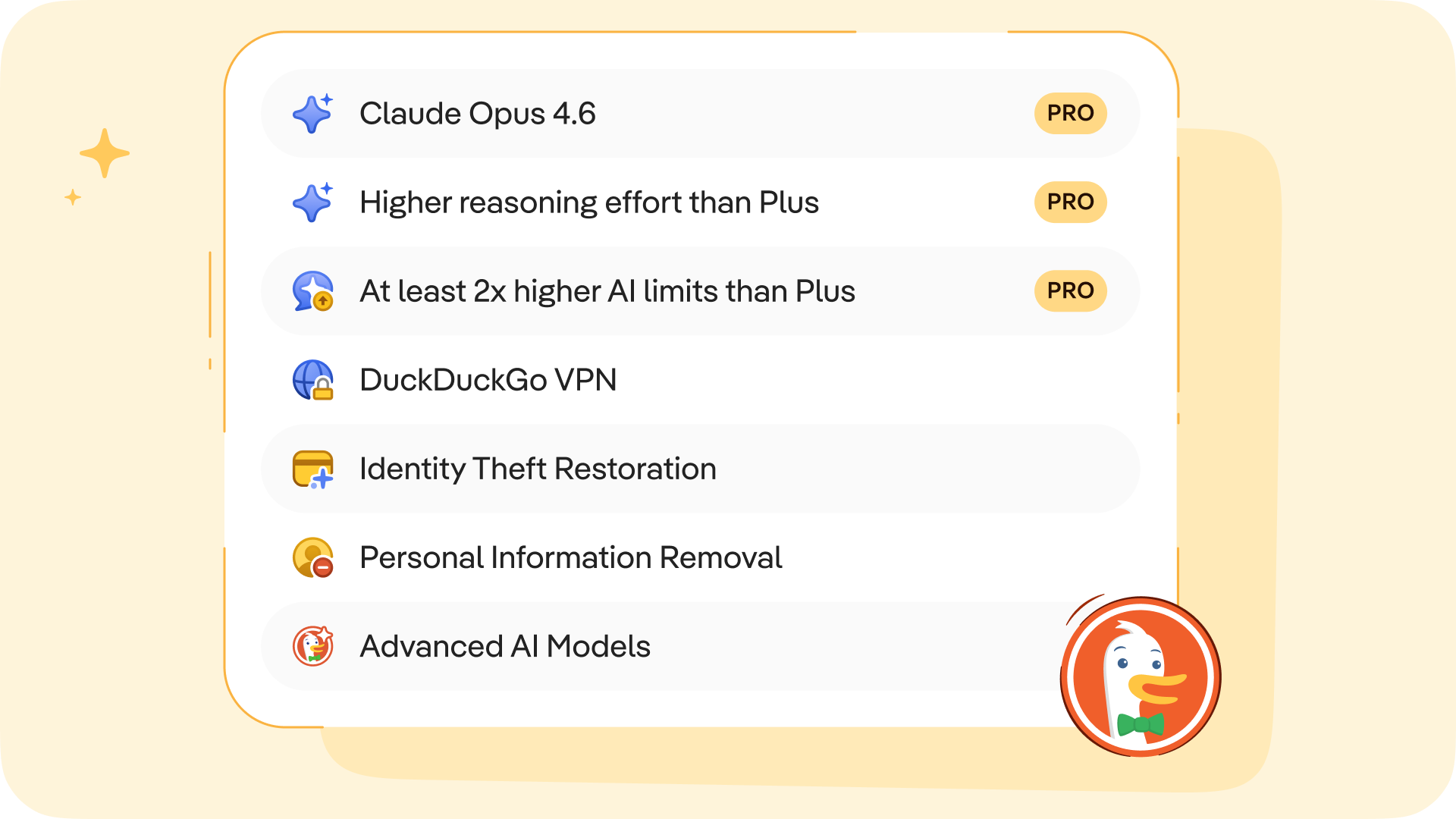
The DuckDuckGo subscription is a four-in-one privacy service that gives you extra protection beyond what's available for free in our web browser, search engine, and private AI chat, Duck.ai. It includes our VPN to encrypt your Internet connection, access to more advanced private AI when you want it, Personal Information Removal to help combat identity theft and spam, and Identity Theft Restoration.
The original DuckDuckGo subscription is now called Plus. (If you’re a current subscriber, this is what you have!) It includes all four protections and costs $9.99 USD/month or $99.99 USD/year. Enhanced with more powerful AI tools, the new Pro plan is $19.99 USD/month or $199.99 USD/year. Subscriptions are available in the U.S., Canada, the E.U., and the U.K. See this help page for international pricing and feature availability.
What are the benefits of the Pro plan?
On Duck.ai, anyone can chat privately with ChatGPT, Claude, and other popular AIs, whether you have a subscription or not. Text chat, voice chat, and image generation are free to use within daily limits. DuckDuckGo subscribers on the Plus plan can do more, with higher usage limits and access to smarter AI models with extended reasoning. But the Pro plan is even more powerful.
We designed Pro for people who use AI frequently throughout the day, or for more demanding tasks that require multi-step reasoning…or both! Subscribers to the Pro plan get three additional Duck.ai upgrades:
- 2x higher usage limits, compared to Plus. This includes text chat, voice chat, and image generation limits across all the AIs available.
- One Pro-exclusive model, currently the newly launched Claude Opus 4.6.
- Access to the highest reasoning available in Duck.ai. Extended reasoning capabilities on GPT-5.2 and Claude Opus 4.6 let the AI spend more time thinking through complex, multi-step problems before responding.
This new Pro plan gives you the freedom to dive deep and iterate back and forth for complicated tasks, whether you’re fine-tuning images, analyzing data, writing long-form content, or making an in-depth plan. Higher limits also mean you don’t have to pick and choose as much; you can use AI for a broad range of day-to-day tasks.
When you take advantage of the extended reasoning on GPT-5.2 or Claude Opus 4.6, you’re more likely to get considered, relevant, and well-structured answers to even very complex prompts. And thanks to the Pro plan’s higher usage limits, you’re less likely to be disrupted in the middle of a complicated job.
Which plan is right for me?
If you primarily use DuckDuckGo to search and browse, and you’re not interested in advanced AI chat or added protections…our free offerings may meet all your needs. If you want to expand your privacy protection with our VPN, or you’re getting more into AI productivity tools, consider Plus! Pro is most suited if you use AI for tasks that require deeper context and multi-step reasoning.
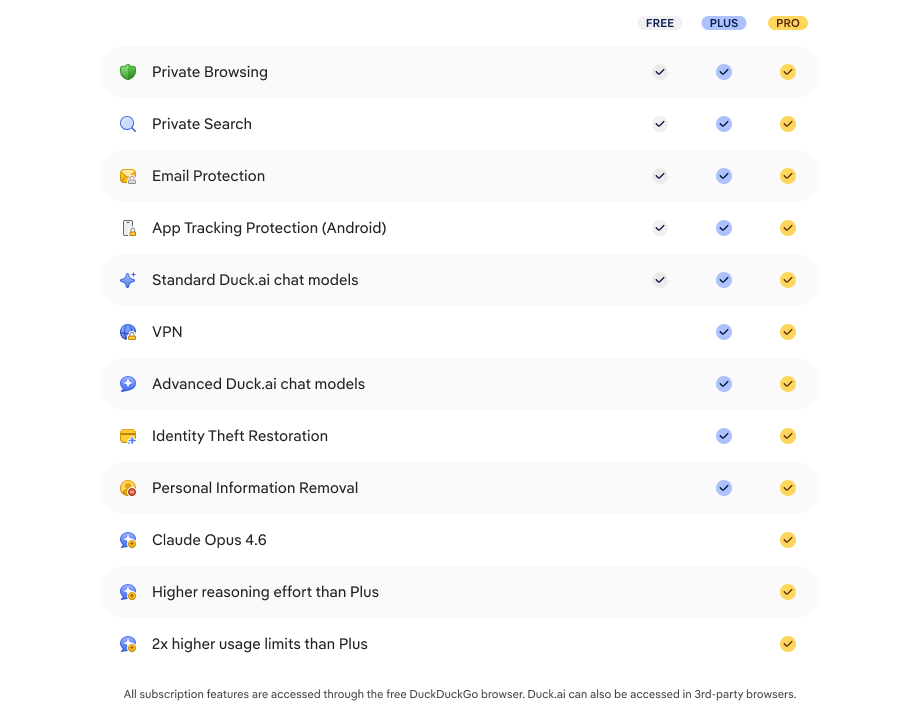
The specific AI models included in each plan are upgraded regularly; at the time of publication, the lineup is as follows:
- Free on Duck.ai: GPT-4o mini, GPT-5 mini, GPT-OSS 120B, Llama 4 Scout, Claude Haiku 4.5, Mistral Small 3.
- Plus: GPT-4o, GPT-5.2 (reasoning), Claude Sonnet 4.5, Llama 4 Maverick, free models.
- Pro: GPT-5.2 (extended reasoning), Claude Opus 4.6 (extended reasoning), Plus and free models.
Can I upgrade an existing subscription?
Yes! As a subscriber, you can switch between the Plus and Pro plan at any time. In the DuckDuckGo browser, go to Settings > DuckDuckGo Subscription. Select View All Plans, pick the plan you'd like to switch to, and proceed to payment or confirm. In third-party browsers, start by navigating to Duck.ai. Just go to Settings & More > Manage Subscription and follow the same steps above.
Ready to give it a try? Head to duckduckgo.com/subscribe to see if the Plus or Pro subscription is right for you!
2025 DuckDuckGo Charitable Donations: $1.1M to privacy and digital competition non-profits around the world
30 Sep 2025, 1:00 pm
2025 marks DuckDuckGo's 15th year of donations—our annual program to support organizations that share our vision of raising the standard of trust online. We are proud to donate to a diverse group of organizations around the world that promote privacy and security, digital competition, and a healthier online ecosystem.
This year, we’re donating $1,100,000, bringing DuckDuckGo's total donations since 2011 to $8,050,000. Everyone using the Internet deserves simple and accessible online protection; these organizations are all pushing to make that a reality. We encourage you to check out their valuable work below.
$100,000 to Public Knowledge

Public Knowledge promotes freedom of expression, an open internet, and access to affordable communications tools and creative works. We work to shape policy on behalf of the public interest.
$75,000 to ARTICLE 19
ARTICLE 19 is an international think-do organisation, that takes its name from the Universal Declaration of Human Rights, and works to propel the freedom of expression movement, fighting censorship, defending dissenting voices and advocating against laws and practices that silence.
$75,000 to the Digital Progress Institute
The Digital Progress Institute seeks to bridge the tech-telecom policy divide through incremental, bipartisan measures in line with its principles of bringing about ubiquitous broadband, 5G and beyond, privacy for every American, real competition in digital markets, and a full-stack framework for Internet policy issues.
$50,000 to the Electronic Frontier Foundation (EFF)

EFF's mission is to ensure that technology supports freedom, justice, and innovation for all people of the world.
$50,000 to European Digital Rights (EDRi)

With more than two decades of advocacy experience, European Digital Rights (EDRi) is the go-to, nongovernmental network working on EU and national laws and policies on privacy, freedom of expression, participation online, data protection and technology policy. EDRi unites over 50 organisations from across Europe (and beyond).
$50,000 to the Foundation for American Innovation

The Foundation for American Innovation, a think-and-do tank based in Washington, D.C. and San Francisco, CA, advances technology, talent, and ideas that support a better, freer, and more abundant future.
$50,000 to the Open Home Foundation
The Open Home Foundation fights for the fundamental principles of privacy, choice, and sustainability for smart homes - and for every person who lives in one. It is best known as the organization that owns and governs Home Assistant, among many other projects crucial to the open home.
$50,000 to Signal
Signal Technology Foundation protects free expression and enables secure global communication through open source privacy technology.
$50,000 to the Surveillance Technology Oversight Project (S.T.O.P.)
The Surveillance Technology Oversight Project (S.T.O.P.) advocates and litigates for privacy, working to abolish local governments’ systems of discriminatory mass surveillance that disproportionately impact vulnerable communities.
$50,000 to Tech Policy Press
Tech Policy Press publishes reporting, analysis, and perspective on events, issues, and ideas at the intersection of technology and democracy.
$50,000 to the Tech Oversight Project
Through engaging with lawmakers, exposing false narratives and bad actors, and pushing for landmark legislation, the Tech Oversight Project seeks to hold tech giants accountable for their anti-competitive, corrupting, and corrosive influence on our society and the levers of power.
$30,000 to the Internet Security Research Group

Our mission at ISRG is to reduce financial, technological, and educational barriers to secure communication over the Internet. We operate three projects (Let’s Encrypt, Prossimo, and Divvi Up) that improve the security and privacy of billions of people using the Internet.
$25,000 to Algorithmic Justice League (AJL)
The Algorithmic Justice League is on a global mission to prevent AI harm using research, advocacy, and art.
$25,000 to the British Institute of International and Comparative Law (BIICL)

The British Institute of International and Comparative Law (BIICL) hosts the Competition Law Forum, a centre of excellence for European competition and antitrust policy and law.
$25,000 to Bull Moose Project

The Bull Moose Project Foundation develops and promotes policies that promote fair markets, support American innovation, and hold Big Tech accountable for anti-competitive and anti-consumer conduct.
$25,000 to Canadian Anti-Monopoly Project
The Canadian Anti-Monopoly Project (CAMP) is a think tank dedicated to addressing the issue of monopoly power in Canada and around the world. CAMP produces research, commentary, and policy to make our economies more fair, free, and democratic.
$25,000 to Consumers International

Consumers International is the global membership organisation for consumer rights groups. Founded in 1960, we bring together over 200 member organisations in more than 100 countries, with a mission to empower and champion the rights of consumers everywhere and to build a fair, safe and sustainable marketplace.
$25,000 to Demand Progress
DPEF empowers people to understand how our communications and governance systems should serve democracy — and how corporate power threatens our economy and our democratic future.
$25,000 to Digital Rights Watch

Digital Rights Watch is Australia's leading digital rights organisation. They defend and promote privacy, democracy, fairness and fundamental rights in the digital age.
$25,000 to Gesellschaft für Freiheitsrechte (GFF)
The Society for Civil Rights e.V. (Gesellschaft für Freiheitsrechte e.V. or "GFF") is a donor-funded organization from Germany that defends fundamental and human rights by legal means. The organization promotes democracy and civil society, protects against disproportionate surveillance and advocates for equal rights and social participation for everyone.
$25,000 to noyb
noyb is committed to the legal enforcement of European data protection laws and has filed more than 850 cases against numerous intentional infringements by Big Tech companies - to make online privacy a reality for everyone.
$25,000 to the Internet Archive

The Internet Archive's mission is to provide “Universal Access yo All Knowledge” by preserving and providing free access to digital materials and cultural heritage serving as a digital library for researchers, historians, scholars, and the public to read, learn, and explore for free.
$25,000 to the Open Rights Group (ORG)

Open Rights Group is the UK’s largest grassroots digital rights campaigning organisation, working to protect everyone’s rights to privacy and free speech online.
$25,000 to the Open Source Technology Improvement Fund (OSTIF)

In the past year, OSTIF collaborations led to the fixing of over 130 findings with security impact. Our security uplifts to open source projects wouldn't be possible without the continued support from DuckDuckGo. We are honored to be part of this program and contribute to a more secure Internet ecosystem.
$25,000 to Perl and Raku Foundation

The Perl and Raku Foundation is dedicated to the advancement of the Perl and Raku programming languages, through open discussion, collaboration, design, and code.
$25,000 to Privacy Rights Clearinghouse

Privacy Rights Clearinghouse focuses on increasing access to information, policy discussions, and meaningful rights so that data privacy can be a reality for everyone.
$25,000 to Restore the Fourth
Restore the Fourth advocates with federal, state and local elected officials, to defend privacy and freedom from unreasonable government surveillance.
$25,000 to the Tor Project

At the Tor Project, we believe everyone should be able to explore the internet with privacy. We advance human rights and defend your privacy online through free, open source software and the decentralized Tor network.
$20,000 to The Markup

The Markup challenges technology to serve the public good by producing investigative journalism, unique tools, and accessible resources to inspire action and agency.
The DuckDuckGo subscription now includes more advanced AI chat models, along with VPN & more
4 Sep 2025, 11:05 am- More advanced AI models from OpenAI, Anthropic, and other providers are now available in Duck.ai as part of the DuckDuckGo subscription, formerly known as Privacy Pro.
- Subscribers can now access OpenAI’s GPT-4o and GPT-5, Anthropic’s Claude Sonnet 4, and Meta’s Llama Maverick – and supercharge productivity at work, school, or home.
- The DuckDuckGo subscription is still the same price: $9.99 USD a month or $99 USD a year. On top of access to premium AI models on Duck.ai, it still includes our VPN, Personal Information Removal, and Identity Theft Restoration*. Sign up at duckduckgo.com/subscribe for a seven-day free trial.
- Keep an eye out for higher DuckDuckGo subscription tiers in the future with access to even more advanced AI models.
A layer of protection for everything you do online – including AI
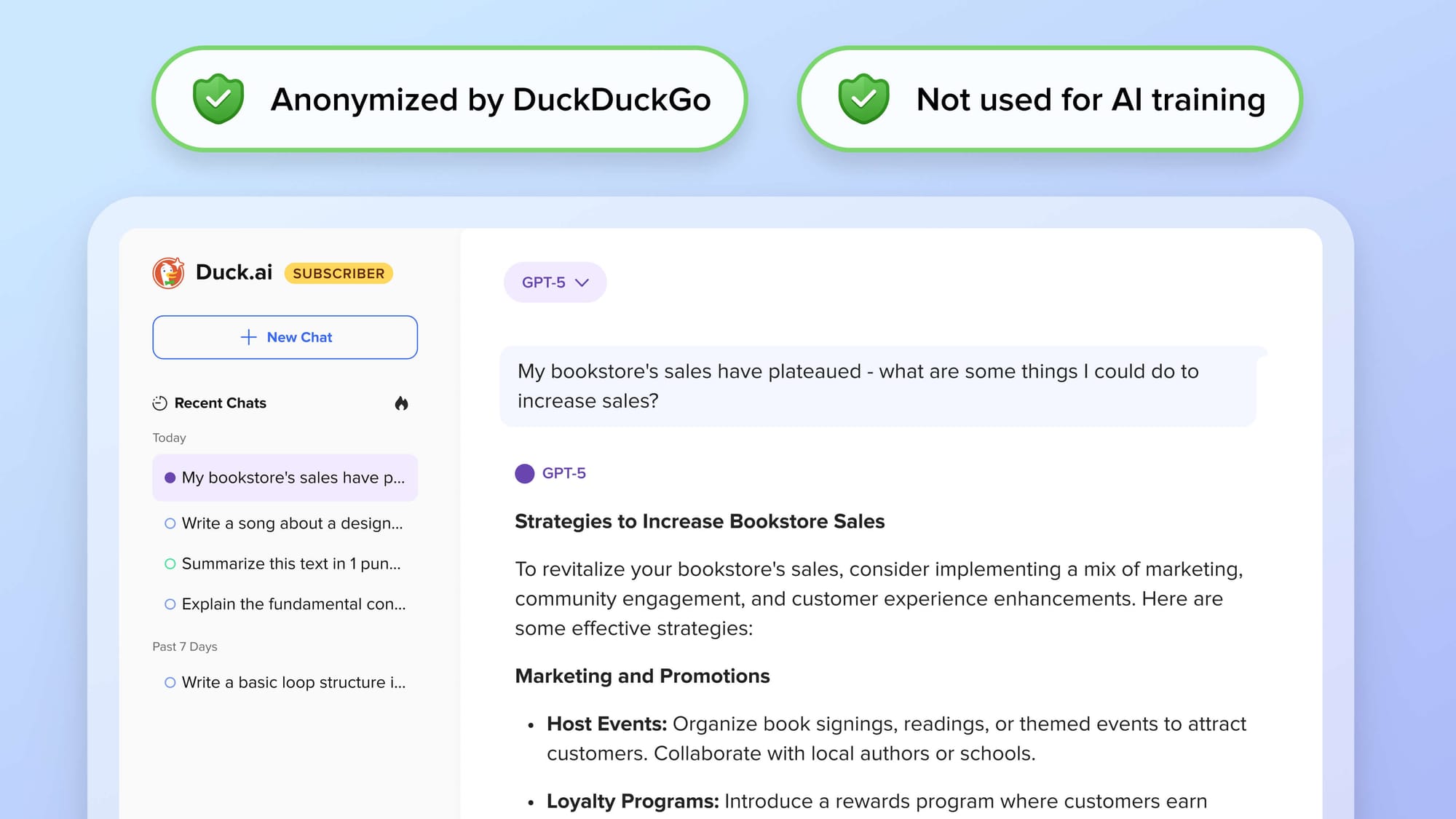
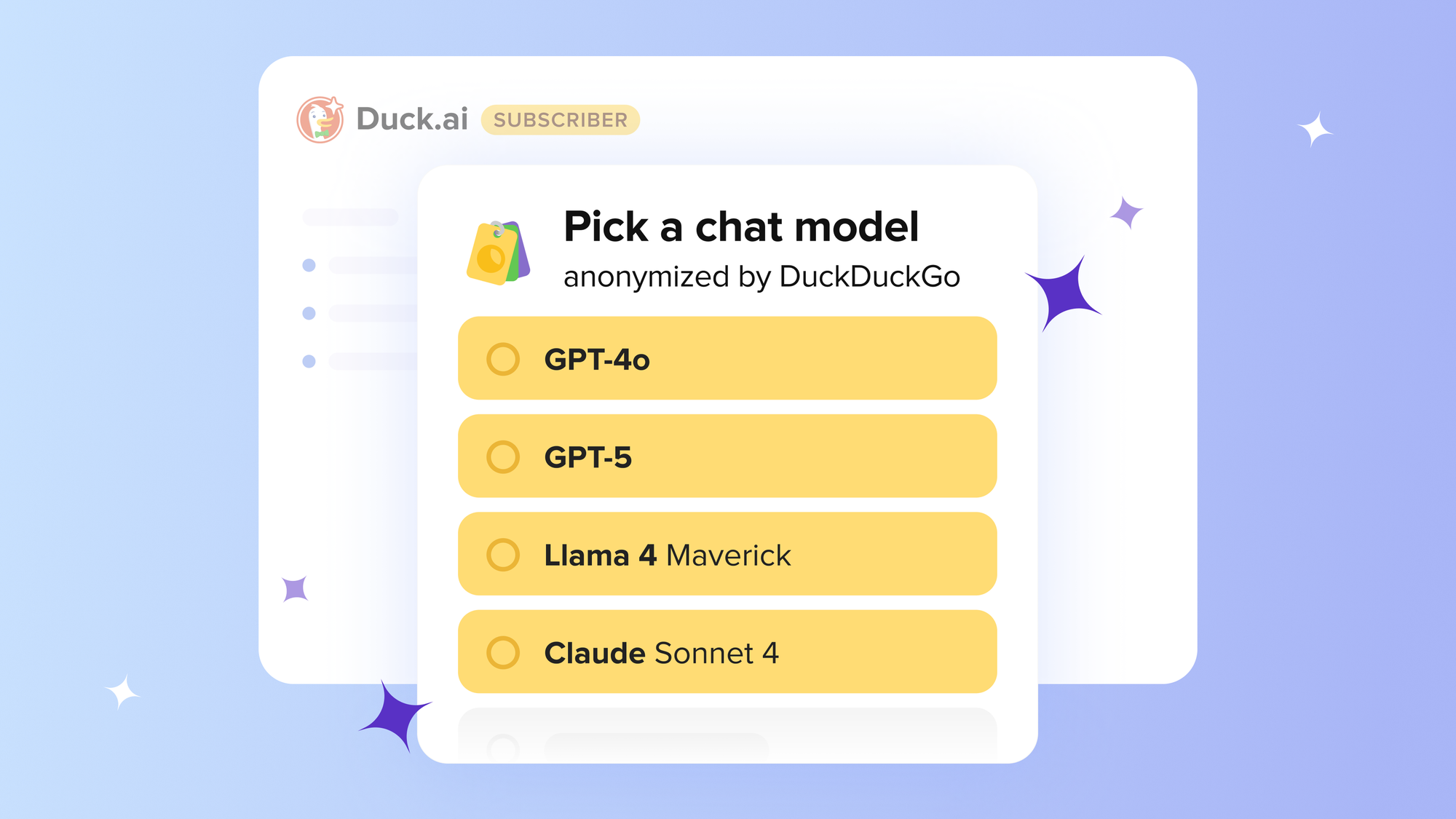
We believe the best way to protect your personal information from hackers, scammers, and privacy-invasive companies is to stop it from being collected at all. To make that happen, we offer a layer of protection for everything you do online. Our browser, for example, is packed with a suite of built-in privacy protections, including our search engine that never tracks you. Our growing suite of private, useful, and optional AI tools is the next evolution.
AI tools have quickly become a significant part of people's online experience, but there’s a gap between how often we use AI, and how safe and in control we feel about it. According to recent Pew research, 27% of US adults use AI tools every day, but 59% feel no control over how AI shows up in their lives. That's why we created Duck.ai, which gives you access to popular AI models from OpenAI, Anthropic, Meta, and Mistral, with the following added protections built by us:
- Anonymized chats. We call model providers on your behalf, so personal information like your IP address is not exposed to them.
- No AI training. Your data is never used to train the AI models.
- Local chat storage. Chats and settings stay on your device to protect your privacy.
- Instant deletion. Erase your chat history in a flash with our Fire Button.
Today, we're expanding Duck.ai by giving DuckDuckGo subscribers access to more advanced AI models, covered by the same strong protections. The base version of Duck.ai is not changing; it’s still free to use, with no account necessary. We’re just adding more models for subscribers. You can see which models are available with and without a subscription here.
Please note that Duck.ai is always optional, whether you’re a subscriber to DuckDuckGo or not. If AI is not for you, you can hide the AI buttons and features from your search settings and your desktop and mobile browser settings. If you use the VPN, for example, but you’re not interested in anonymized AI chat, that’s no problem. Just head to your browser’s Settings menu to turn off the AI features and continue using your VPN normally.
What does the DuckDuckGo subscription include?
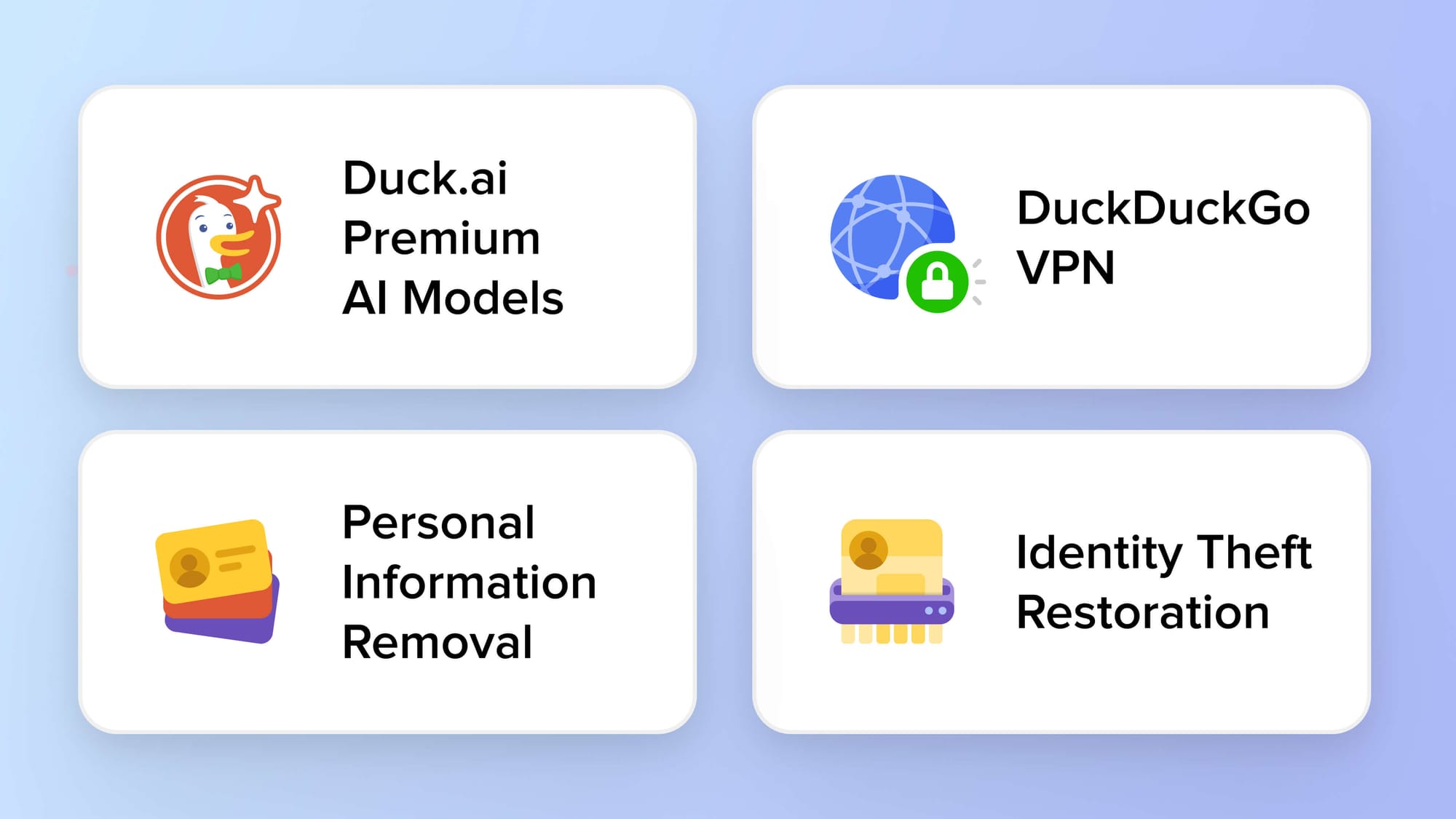
Formerly known as Privacy Pro, the DuckDuckGo subscription expands the great protection you get from DuckDuckGo’s free offerings, covering even more of what you do online:
- DuckDuckGo VPN. Built for speed and simplicity, the DuckDuckGo VPN secures your WiFi connection on your entire device, hiding your location and IP address from the sites you visit. Includes full-device coverage on up to five devices at once. Learn more.
- Personal Information Removal. Helps remove personal information like your name, address, and family connections from people search sites that store and sell it, helping to combat identity theft and spam. Available for Mac and Windows.* Learn more.
- Identity Theft Restoration. If your identity is stolen, get expert guidance as you get back on track. Brought to you by Iris (Iris Powered by Generali) — a world leader in identity theft restoration.* Learn more.
- NEW: More Advanced AI models. Subscribers can now access OpenAI’s GPT-4o and GPT-5, Anthropic’s Claude 4 Sonnet, and Meta’s Llama Maverick, in addition to all the free-tier chat models. Models are updated regularly. See the full list here.
The price is staying the same in all regions: $9.99 USD/month or $99 USD/year, with international pricing information available on this help page.
Achieve more with advanced models
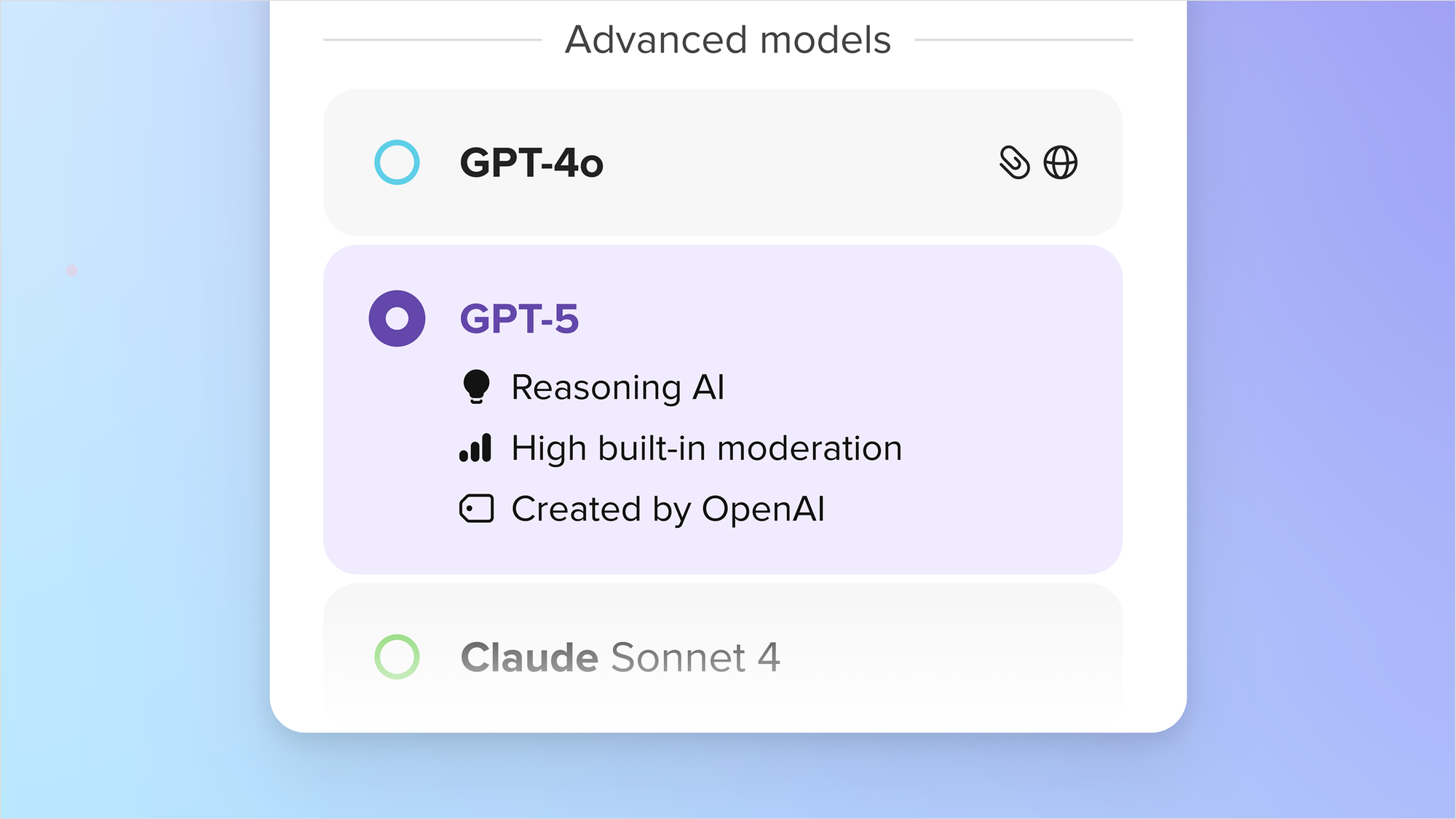
More advanced AI models like OpenAI’s GPT-4o are built to handle more complicated tasks than their smaller counterparts like GPT-4o mini. These bigger models are better at following detailed instructions, maintaining context through extended chats, and delivering deeper, more nuanced responses. The DuckDuckGo subscription offers a way to use some of these models, but with more privacy. Even larger and more highly advanced models will be made available through higher subscription tiers in the future.
If you’re a frequent user of different advanced chatbots, the DuckDuckGo subscription is an easy one-stop solution. It lets you access multiple premium models in one place, rather than juggling multiple subscriptions and apps. Your subscription lets you visit Duck.ai and use those premium models in any browser you like. But it's especially convenient within the DuckDuckGo browser, where Duck.ai is seamlessly integrated on both desktop and mobile. Using the DuckDuckGo browser, you can access AI chat when and where you need it, getting support for specific tasks without switching platforms. And as always, it’s completely optional – you can adjust or turn off Duck.ai’s integrations from your browser’s settings menu.
Whether you subscribe for premium models or stick with the free tier, you get the same strong privacy protections.
Is the DuckDuckGo subscription worth it?
When you get a DuckDuckGo subscription, you get instant, full access to any or all the features you want, without complex add-ons – at a price competitive with any of the individual features on their own. The $9.99 USD monthly price tag is more cost effective than maintaining multiple separate AI subscriptions – many of which are in the $20/month range. (See this help page for more international pricing information.)
Additional features like the DuckDuckGo VPN and Personal Information Removal service add value and convenience – and everything is available in one place, your DuckDuckGo browser.
Want to give it a try for free? You can get a 7-day trial of the subscription in the DuckDuckGo Browser's settings. In the US, you can also access the 7-day trial at DuckDuckGo.com/subscribe.
How to access Duck.ai and activate your subscription
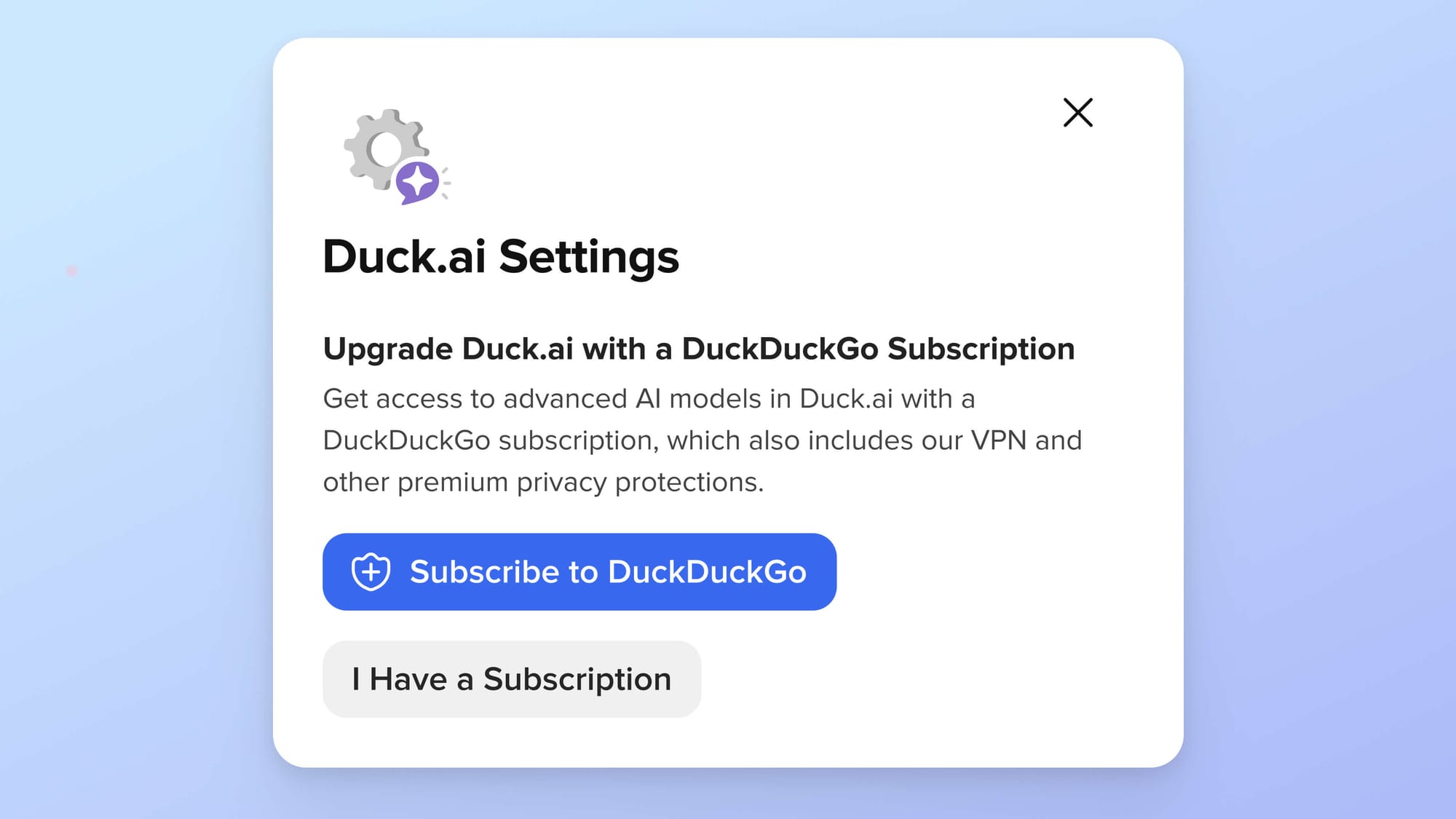
Duck.ai can be accessed from any browser. Just visit duck.ai or hit the Duck.ai button on any search engine results page on duckduckgo.com. From there, paid subscribers can head to Duck.ai Settings, click “I Have A Subscription”, and follow the prompts to access the premium models.
If you are using the DuckDuckGo browser, you can use more subscription features, like the VPN and Personal Information Removal*. You also have even more ways to get to Duck.ai! You can click the optional Duck.ai buttons in our desktop and mobile browsers, use one of our iOS widgets, or press and hold the DuckDuckGo icon on iOS or Android. However you get there, the process for activating your subscription is the same.
Learn more about the DuckDuckGo subscription and sign up at duckduckgo.com/subscribe
*The DuckDuckGo subscription is available in the U.S., Canada, the E.U. and the U.K. All subscribers can use the VPN and access the same premium AI models, regardless of region. Personal Information Removal is available to U.S.-based subscribers. Identity Theft Restoration coverage varies by region. Learn more here.
Try Privacy Pro for 7 Days with New Free Trials
5 Aug 2025, 8:09 pm
Privacy Pro is our privacy-protecting subscription service that includes the DuckDuckGo VPN, Personal Information Removal to protect yourself from data brokers, and Identity Theft Restoration, which you can call if your identity is ever stolen.
In the year since we launched Privacy Pro, we’ve been working hard behind the scenes to make it more comprehensive, more powerful, and easier to use. Have you been waiting for the perfect moment to sign up? Good news: you can now try Privacy Pro free for 7 days. The free trial is available on all platforms – sign up here to redeem the offer. After your free trial, you can continue at $9.99 USD/month or $99.99 USD/year. (International pricing information here.)
Here’s a look at the major improvements we’ve made in the past year! To learn even more about Privacy Pro, you can visit our blog and Help Pages.
Overall Improvements
International Availability
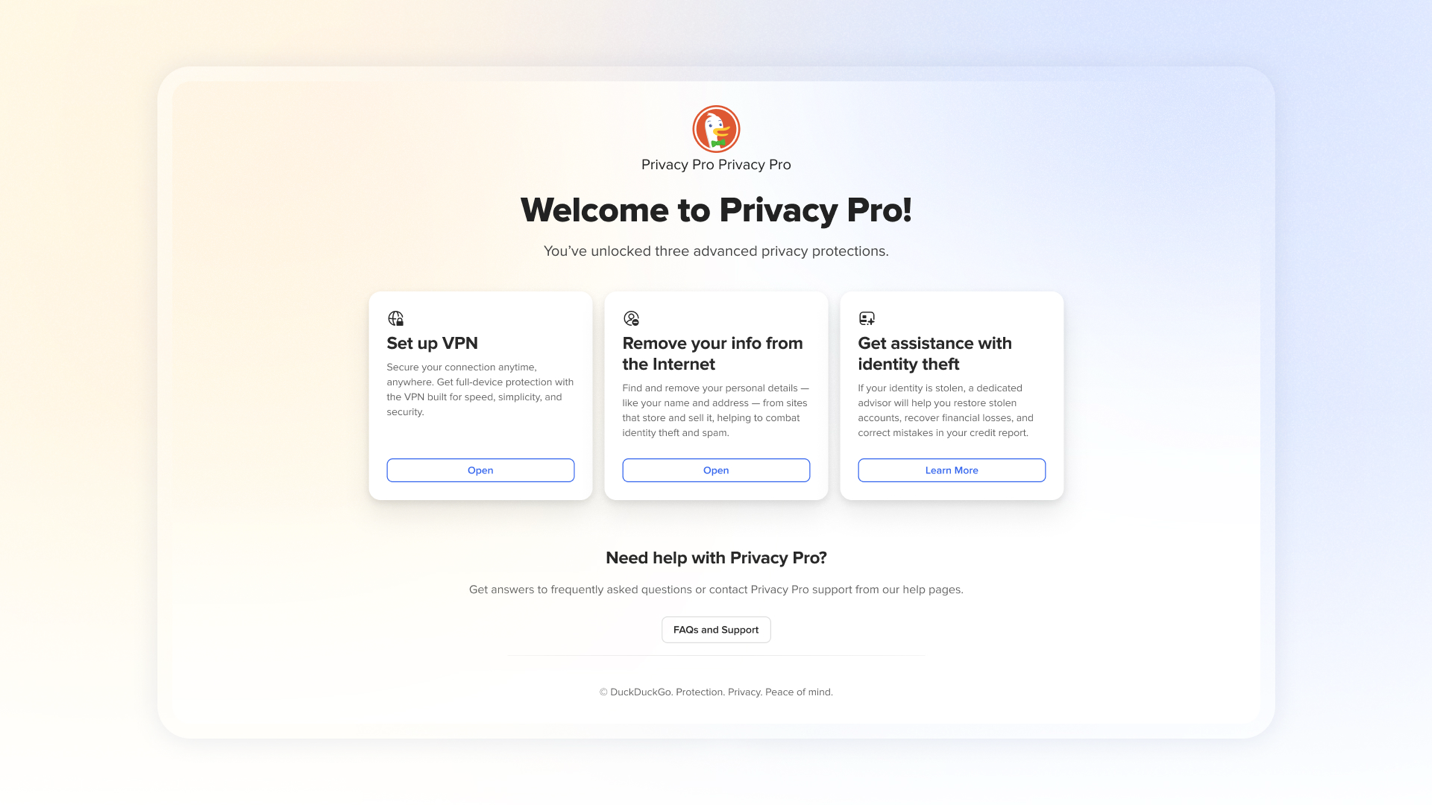
Privacy Pro subscriptions are now available in the U.S., E.U., Canada, and the U.K. Features and coverage vary by region, but the DuckDuckGo VPN works the same in all regions. You can now use Privacy Pro in more languages including Dutch, French, German, Italian, Polish, Portuguese, Russian, and Spanish. Learn more about using Privacy Pro outside the U.S. here.
DuckDuckGo VPN Improvements
More Server Locations
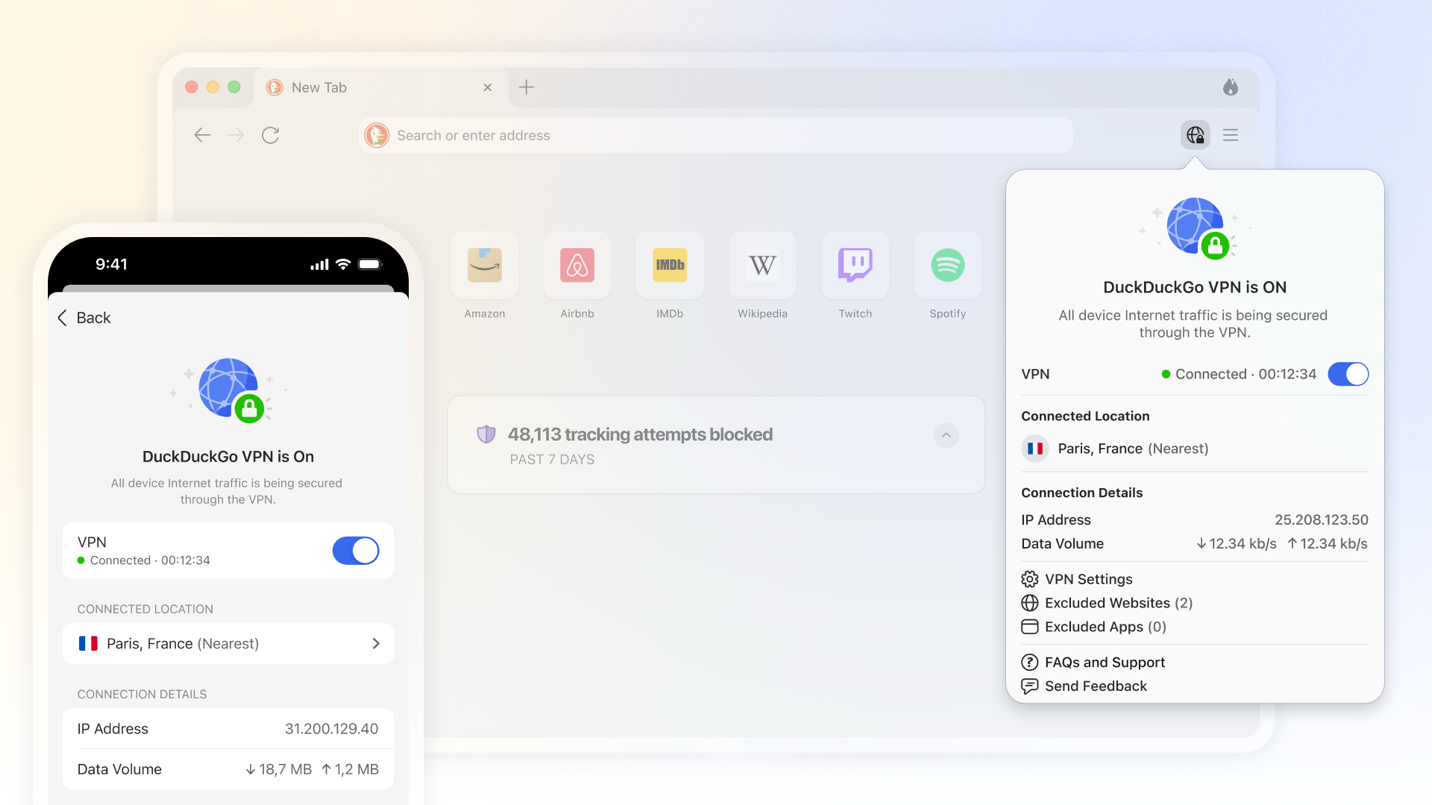
DuckDuckGo VPN users can now choose from more than 40 locations in 30+ countries. Check out the full list here.
Independent Security Audit
We partnered with Securitum to conduct a comprehensive security audit of the DuckDuckGo VPN and supporting infrastructure. We're pleased to report that it found no critical vulnerabilities, underscoring the strong security measures we have in place for our VPN! Visit this help page for a summary of the key findings, remediations, and accepted risks, plus a link to the full report.
Block Risky Domains Automatically
The DuckDuckGo VPN now automatically blocks known phishing, malware, and scam sites – no matter what browser you're using. This new setting is on by default on all platforms.
Now On All Platforms: VPN Notifications
All users can now get notifications that display VPN status at a glance. These notifications are on by default but can be disabled in your VPN Settings.
Desktop: Automatic VPN Connection
All desktop users now have a setting that lets the VPN connect automatically when you log in to your computer.
Desktop: Introduced App and Website Exclusions
Because some apps and websites aren’t compatible with VPNs, we made sure you can exclude them from our VPN. This lets you use those incompatible apps and websites on desktop without disconnecting from the VPN. (App exclusions are also available on Android. Not compatible with iOS.) Manage website and app exclusions in your VPN settings; you can also manage website exclusions by clicking on the VPN icon in the toolbar.
IOS: VPN Widgets and Siri Shortcuts
We created VPN widgets for the iOS home screen and Control Center, so you can quickly connect or disconnect from the VPN and see your VPN connection status at a glance. We also added a Siri Shortcut.
Mobile: VPN Snooze
Both iOS and Android users can now “snooze” the VPN for easier access to sites and apps incompatible with VPNs.
Android: Automatically Pause VPN During Wi-Fi Calls
To help avoid dropped calls on Android, we introduced a setting that temporarily snoozes the DuckDuckGo VPN during Wi-Fi calls. The best part? We automatically restore your VPN connection when you end your call.
Android: Implemented Auto-Excluded Apps
Our new auto-exclude feature on Android automatically detects apps that aren’t compatible with VPNs and bypasses them, so you won’t need to manually adjust settings. (If you would like to adjust this feature, you can! Just go to Settings > VPN > Manage Apps.)
Custom DNS for Windows, iOS, Mac, and Android
You can now switch between the default DuckDuckGo DNS resolvers and a custom DNS resolver of your choosing in VPN Settings > Advanced Settings.
Personal Information Removal Improvements
New Personal Information Removal Dashboard
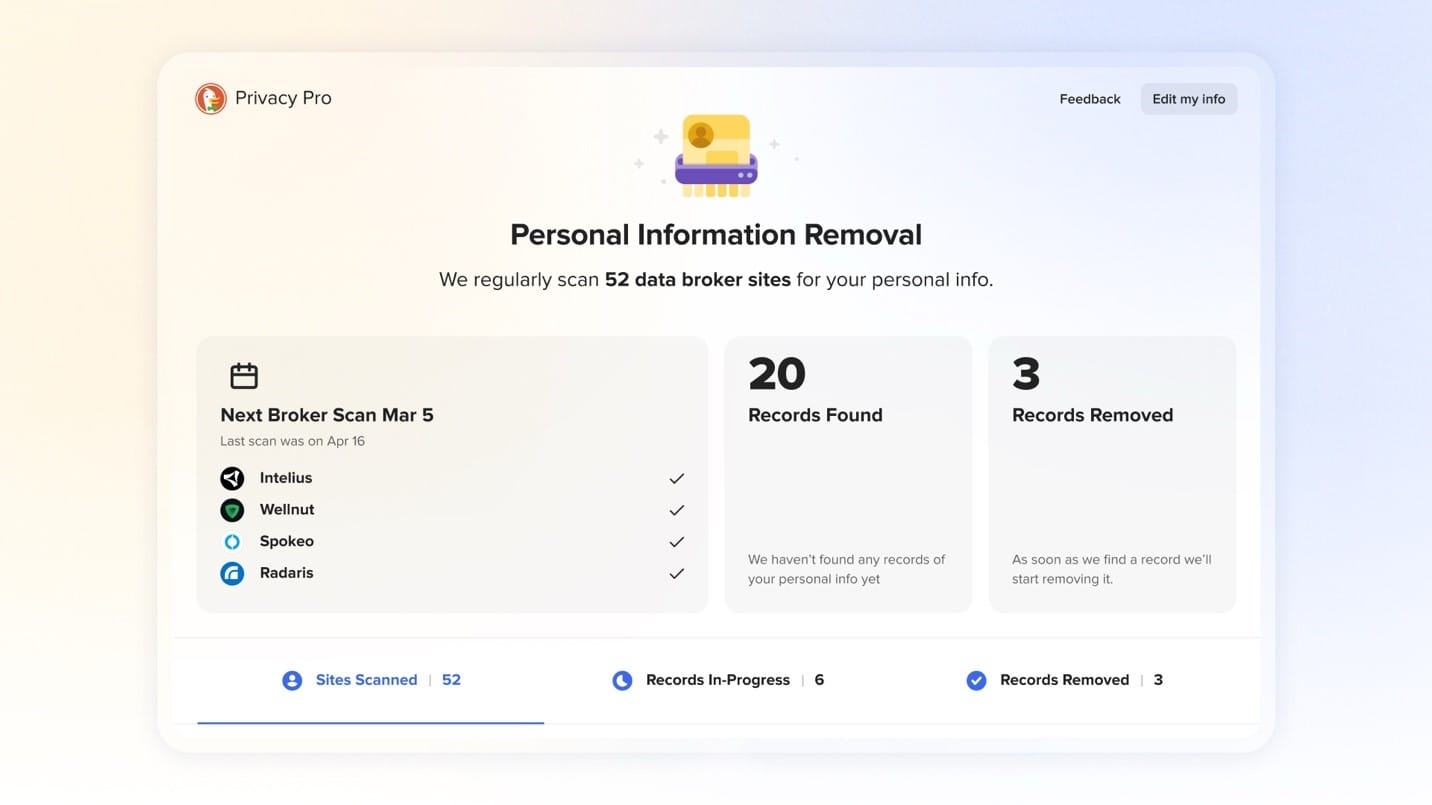
We completely redesigned the Personal Information Removal dashboard to give Privacy Pro subscribers more insight into the data removal process. You can more easily see when a site was last scanned, how many records have been removed, which sites are clear of your personal information, and more.
Personal Information Removal Request Timeline
Monitor your data broker removal requests with our new Removal Request timeline. You can track the progress of each request, see when your data has been removed, and get help with next steps if any removals take longer than expected.
More Data Brokers Covered
Privacy Pro now covers over 80 data broker sites and counting, including FastPeopleSearch, MyLife, and OfficialUSA.com. Check out the full list here. Some competitors only re-scan data broker sites on a monthly or quarterly basis…or not at all! But we re-scan the sites every 10 days, submitting new removal requests if your data has reappeared.
Improved Scan Performance
Personal Information Removal now more reliably detects when your information has been removed from the data broker sites. Your first scan after signing up or updating your profile now happens 10x faster than before.
What’s Next for Privacy Pro?
Even more improvements are coming soon. We’re working on adding an upgraded AI chat experience to your subscription, with anonymized access to more advanced chat models than the free version on Duck.ai. We’re adding more data brokers to Personal Information Removal all the time, and we’re working on bringing the feature to mobile. Your feedback helps us catch and address bugs, too – so keep it coming!
Go here to redeem your free trial today. Follow us on social [Reddit/X/Facebook/Linkedin] for updates about all things DuckDuckGo, including more Privacy Pro improvements.
The DuckDuckGo Browser: Fresh New Look, Same Great Protections, AI Optional
22 Jul 2025, 7:24 pm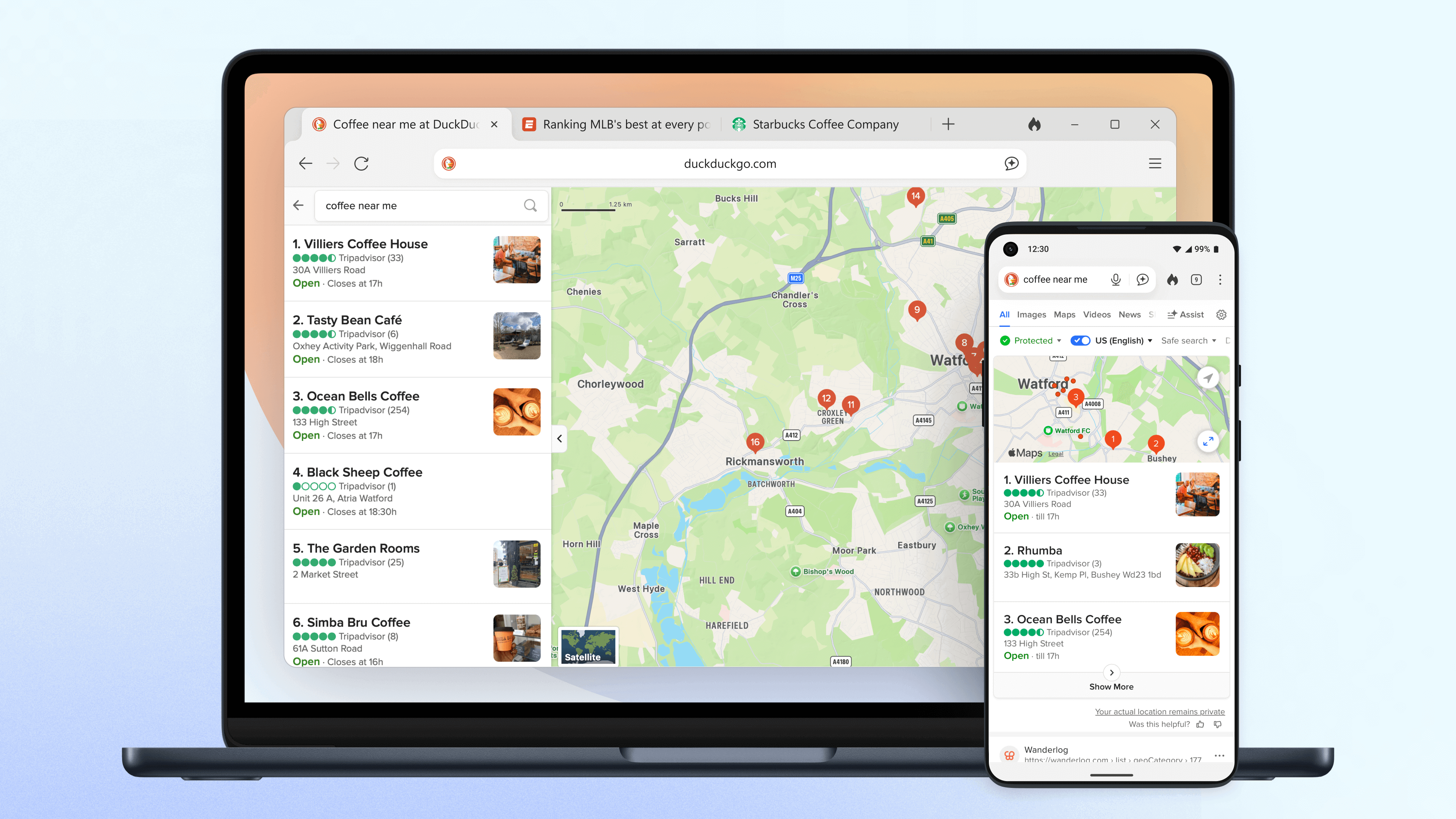
Have you been using the DuckDuckGo browser for a while? If so, you may have noticed a few changes around here! As you navigate through the browser, you’ll notice redesigned icons, a softer, rounder interface, and a fresh color palette. Moving between desktop and mobile is more seamless than ever. And new interactive elements show you exactly how DuckDuckGo is protecting you.

Fresh Visuals, Seamless Protection
We’ve updated our browser’s visual design with a new color palette and softer, rounder shapes, including new icons that we designed in-house. This new look reflects what we believe the internet should feel like with real privacy protection: calm instead of chaotic, streamlined instead of cluttered, secure instead of surveilled.

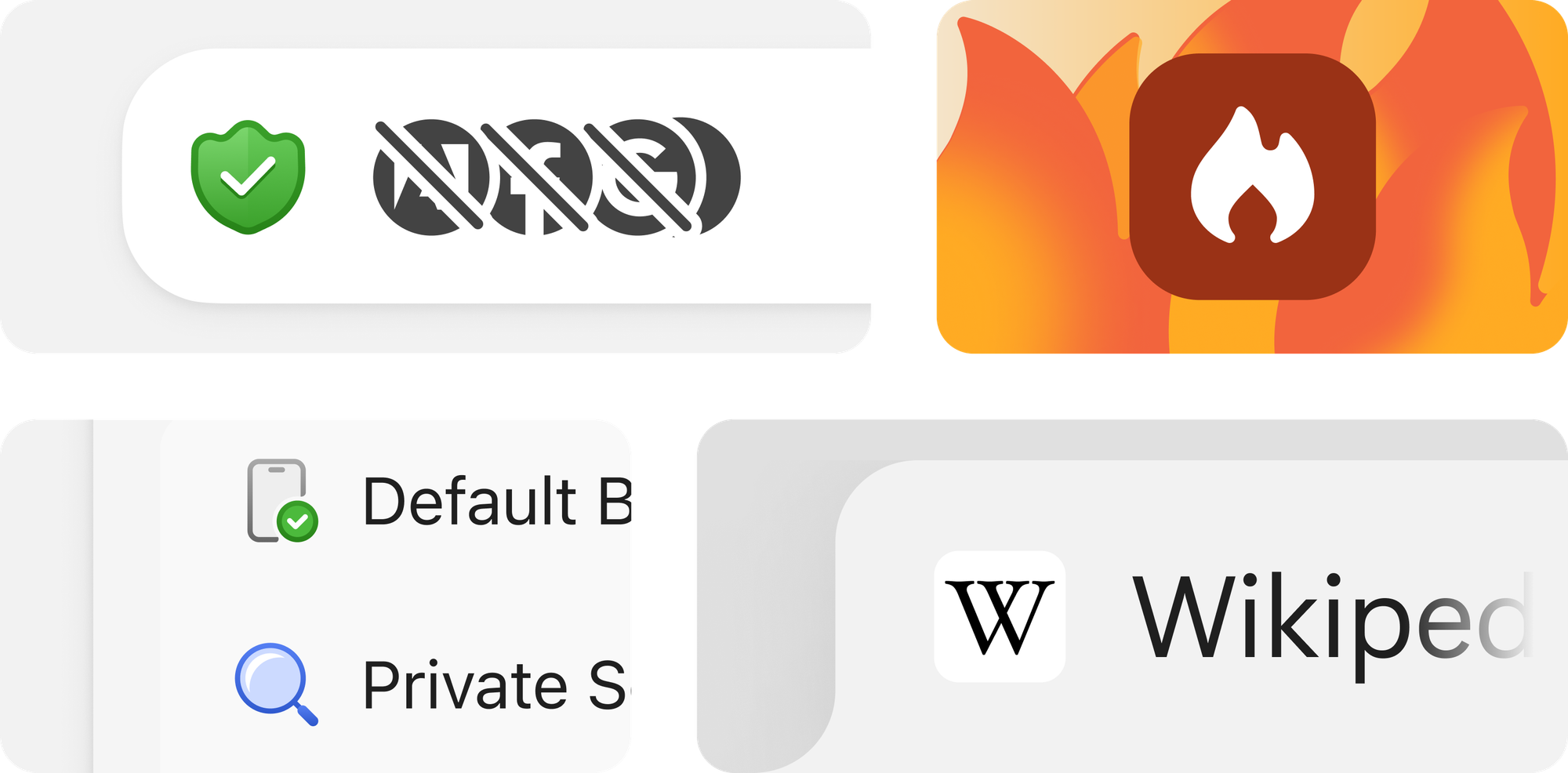
Hit the green duck-foot shield in the redesigned address bar for real-time information about our tracking protections. Use the redesigned Fire Button to delete your browsing data with one click. Other changes you’ll notice include smoother, softer tab lines and a roomier address bar.
Private, Useful, and Optional AI
We’ve also made it easier than ever to access our private, useful, and optional AI features. Add a Duck.ai button to your URL bar for quick access to free, anonymized AI chats – available on both desktop and mobile.

These new buttons join several other convenient access points. On iOS, get to Duck.ai via Siri shortcut or widgets for your Lock Screen and Control Center. On Android, you find a shortcut by pressing and holding the DuckDuckGo app icon. (There’s also a Duck.ai button on our search results page when you visit duckduckgo.com, which can be toggled on and off here.)
Don’t use Duck.ai? You can disable the feature and hide the buttons in your browser’s Settings menu.
Tell Us What You Think
We love our browser’s new look – and we hope you do, too. If you have comments or questions, you can join our active community on Reddit or reach out on social media (Facebook | Linkedin | X).
DuckDuckGo Browser’s Scam Blocker Expands to Include Protection from More Threats
19 Jun 2025, 11:41 am- The DuckDuckGo browser’s built-in Scam Blocker guards against phishing sites, malware, and other common online scams. It’s on by default, so you’re protected as soon as you open the browser.
- NEW: Scam Blocker now also covers sham e-commerce sites, fake cryptocurrency exchanges, “scareware” that falsely claims your device has a virus, and other sites known to advertise fake products or services.
- Most browsers use Google tools for their phishing and malware protections, sending browsing data to Google in real time. We don’t. We designed Scam Blocker ourselves, with data from Netcraft, an independent cybersecurity company. Our scam protections don’t require an account, and we don’t share your browsing data with third parties.
- Scam Blocker is available for free within the DuckDuckGo browser on desktop and mobile. DuckDuckGo subscribers get full-device coverage when logged into the DuckDuckGo VPN – even when using other browsers.
Scam Blocker: Multiple protections for multiple threats
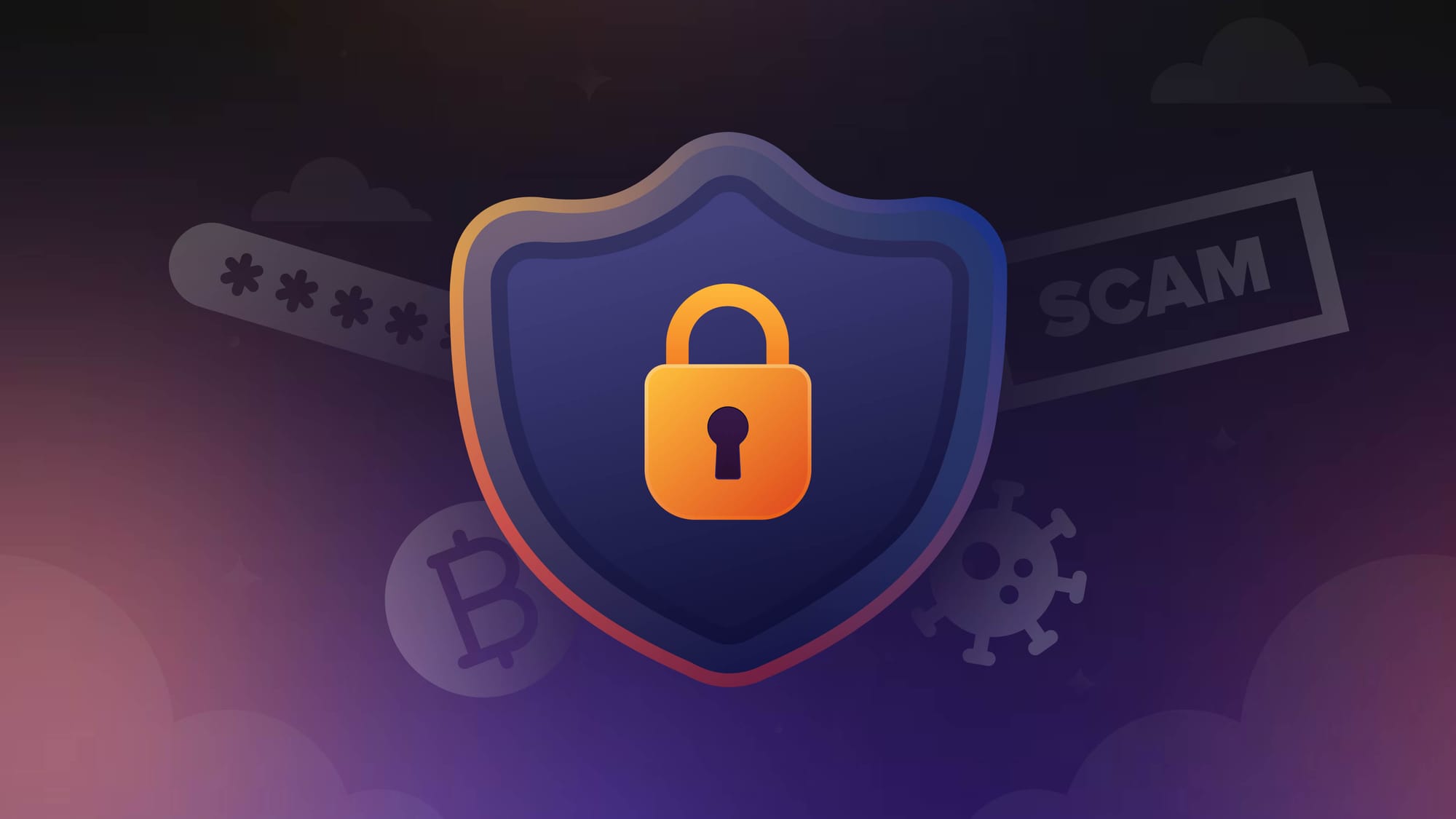
It’s not your imagination – online scams are getting more sophisticated. According to new reporting from the United States’ Federal Trade Commission, consumers lost $12.5 billion to fraud in 2024 alone. Scams related to investments, online shopping, and internet services were among the worst offenders.
Around here, we believe the best way to protect your personal information from hackers, scammers, and privacy-invasive companies is to stop it from being collected at all. Our browser and built-in search engine never track your searches, and our browsing protections help stop other companies from collecting your data, too. One of those protections is our Scam Blocker, designed and built by us for your security and your privacy. Scam Blocker guards against phishing sites, malware, and other common online scams without tracking your browsing data or sharing it with any third parties. It’s built into the DuckDuckGo browser and free to use, with no signup required.

Fake cryptocurrency offers, urgent messages about "viruses," and high-paying surveys – like the hypothetical examples above – are some of the common scam sites covered by DuckDuckGo’s Scam Blocker.
Scammers and cybercriminals have constantly evolving tactics, so it’s important to stay protected on multiple fronts. Thanks to Scam Blocker, the DuckDuckGo browser can help you spot and avoid some of the most common types:
- NEW PROTECTION: Scam investment sites, storefronts, surveys and more. Designed to trick you into giving away personal information or making bad financial transactions under false pretenses. These scam sites can include investment offers, cryptocurrency trading schemes, discounted pharmaceutical products, affiliate surveys with cash rewards, and more; the sites can look legitimate, but the offers are often “too good to be true.”
- NEW PROTECTION: Scareware. These alarming sites claim that your computer or phone is infected with spyware or viruses. Scareware creates a false sense of urgency to trick people into engaging with fake “tech support” and buying unwanted – or completely fake – antivirus software.
- Phishing sites. Phishing generally uses impersonation to get your login credentials or sensitive personal information. Cybercriminals’ phishing techniques include creating sham websites that look like a familiar legitimate business and using link redirects to get unsuspecting users there.
- Malware sites. If you download a harmless-looking file from one of these sites, malware can infect your phone or computer, causing damage or extracting personal information for later use. Some malware sites start an automatic download before you even click or enter anything.
- Tracker-powered malicious ads. “Malvertising” typically involves injecting malware-laden advertisements into legitimate websites and online ad networks. Some malicious ads can compromise your system even if you don’t click on them.
The scam tactics vary, but the end goals are usually the same: to commit financial fraud using your personal information or to trick you into paying for products or services that don’t exist. If you accidentally click a link that would take you to one of these scammy sites, DuckDuckGo’s built-in Scam Blocker will stop the page from loading and show you a warning message that allows you to navigate safely away. The DuckDuckGo browser also reduces your malicious ad risk while you browse, blocking tracker-powered ads while before they load.
Other browsers like Chrome, Firefox, and Safari rely on Google’s Safe Browsing Service to provide warnings about phishing sites, which involves sending information to Google. We don’t. We built our own anonymous solution that doesn’t send data to any third parties. No sign in, no tracking, and it’s on by default, so you're protected from the moment you open the browser. DuckDuckGo subscribers can connect to the DuckDuckGo VPN to get these protections for your whole device – including in other browsers!
How Scam Blocker works
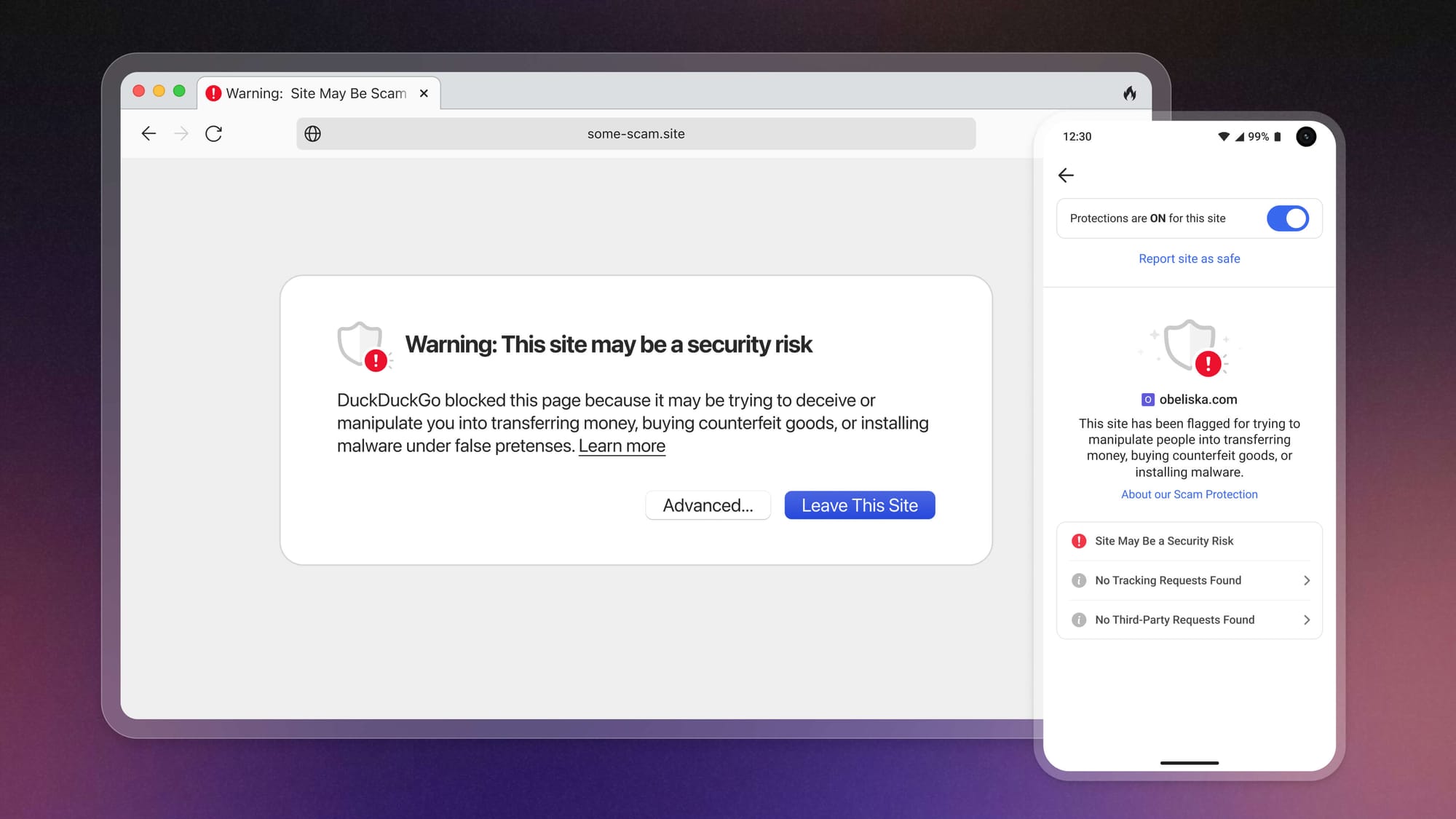
When you land on a potentially dangerous website, Scam Blocker will display a warning message before loading the site.
New scam sites pop up all the time, but the DuckDuckGo browser stays on top of it. We get a feed of malicious site URLs from Netcraft, an independent cybersecurity company that’s always scanning for new threats. We store that constantly refreshing list on our servers and pass any updates to your browser every 20 minutes.
The way Scam Blocker works is always anonymous. Once your browser downloads the latest dangerous site list from DuckDuckGo, it’s available locally on your device. When you navigate to a site, your browser first checks the site against the list stored on your device. If the site is on the list, your browser shows a warning message that gives you the option to navigate away safely or to continue to the site at your own risk.
Most of the potentially dangerous URLs flagged by Scam Blocker can be found on common sites like Google Drive or GitHub. Uncommon threats – which we encounter less than 0.1% of the time! – require an extra verification step that checks websites against a larger and more comprehensive database on DuckDuckGo servers. But this process is also anonymous; at no time during the threat verification process does your device communicate with any third parties. For a deeper dive on the cryptography we use to maintain anonymity when handling uncommon threats, visit this Help Page.
All this means that your searches and browsing history are still completely anonymous.
Note: This blog post has been edited since initial publication to stay up to date with our evolving product offerings.
Private, Useful, and Optional AI: DuckDuckGo offers free access to popular AI chatbots at Duck.ai and expands AI-assisted answers on its search engine
6 Mar 2025, 12:41 pm- DuckDuckGo’s approach to AI is to provide private, useful, and optional AI features – including chat and search instant answers – to people who want the productivity benefits of AI without the privacy risks.
- Now out of beta: Get free, anonymized access to popular chatbots at Duck.ai. Easily move traditional search results – which now include more AI-assisted answers from web sources – to Duck.ai to continue your conversation.
- Both Duck.ai and AI-assisted answers are free to use, with no account required. We now serve millions of AI-assisted answers daily. If you opt to show them "often" in your settings, they should appear in our traditional search results over 20% of the time.
- Recent updates to AI-assisted answers include expanding sources across the web, beyond just Wikipedia; answering English-language queries outside the U.S.; and adding customization that lets you decide how often you want
answers to appear: often, sometimes (default), on-demand, or never. - Recent Duck.ai chat updates include upgraded models (GPT-4o mini and o3-mini from OpenAI, Meta Llama 3.3, Mistral Small 3, and Claude 3 Haiku from Anthropic) and a “Recent Chats” feature that stores conversations locally on your device – not on DuckDuckGo or other remote servers.
Our approach to AI: private, useful, and optional.
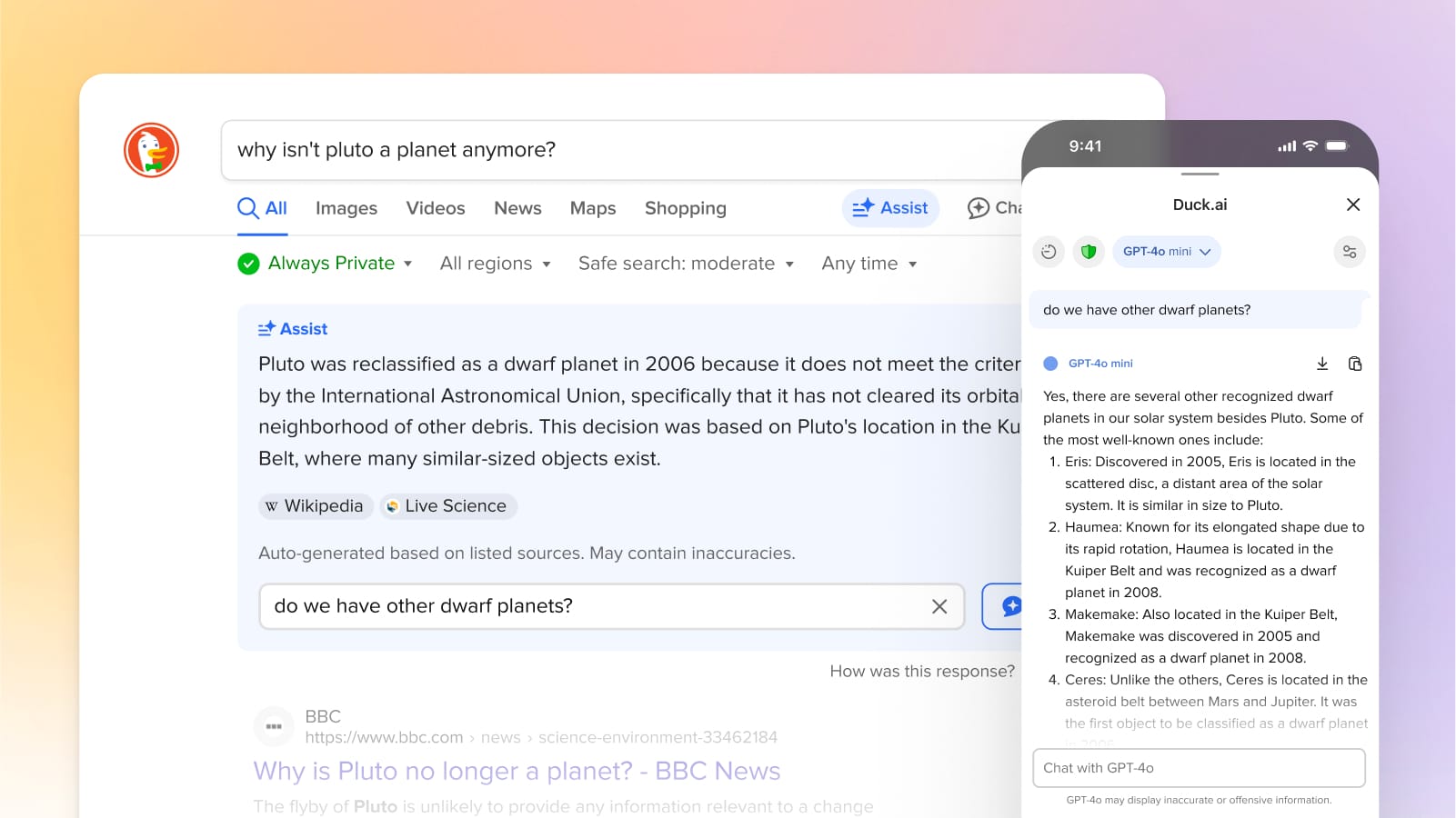
At DuckDuckGo, we believe the best way to protect your personal information from hackers, scammers, and privacy-invasive companies is to stop it from being collected at all. We started with a search engine that doesn’t collect your search history; our flagship experience is now a browser with a suite of built-in protections that includes our search engine, ad and cookie blocking, and many more protections.
Our approach to AI extends this strategy by integrating protected AI features that offer the productivity benefits of AI without privacy risks like tracking your prompts and training on your data.
We’re not making AI features just for the sake of making AI features. They have to be actually useful in everyday use, starting with helping people get faster, high-quality answers to their questions. However, we recognize not everyone wants AI in their lives right now, and that’s OK with us. That’s why all our AI features are optional and can be turned off or tuned down.
To chat or not to chat.
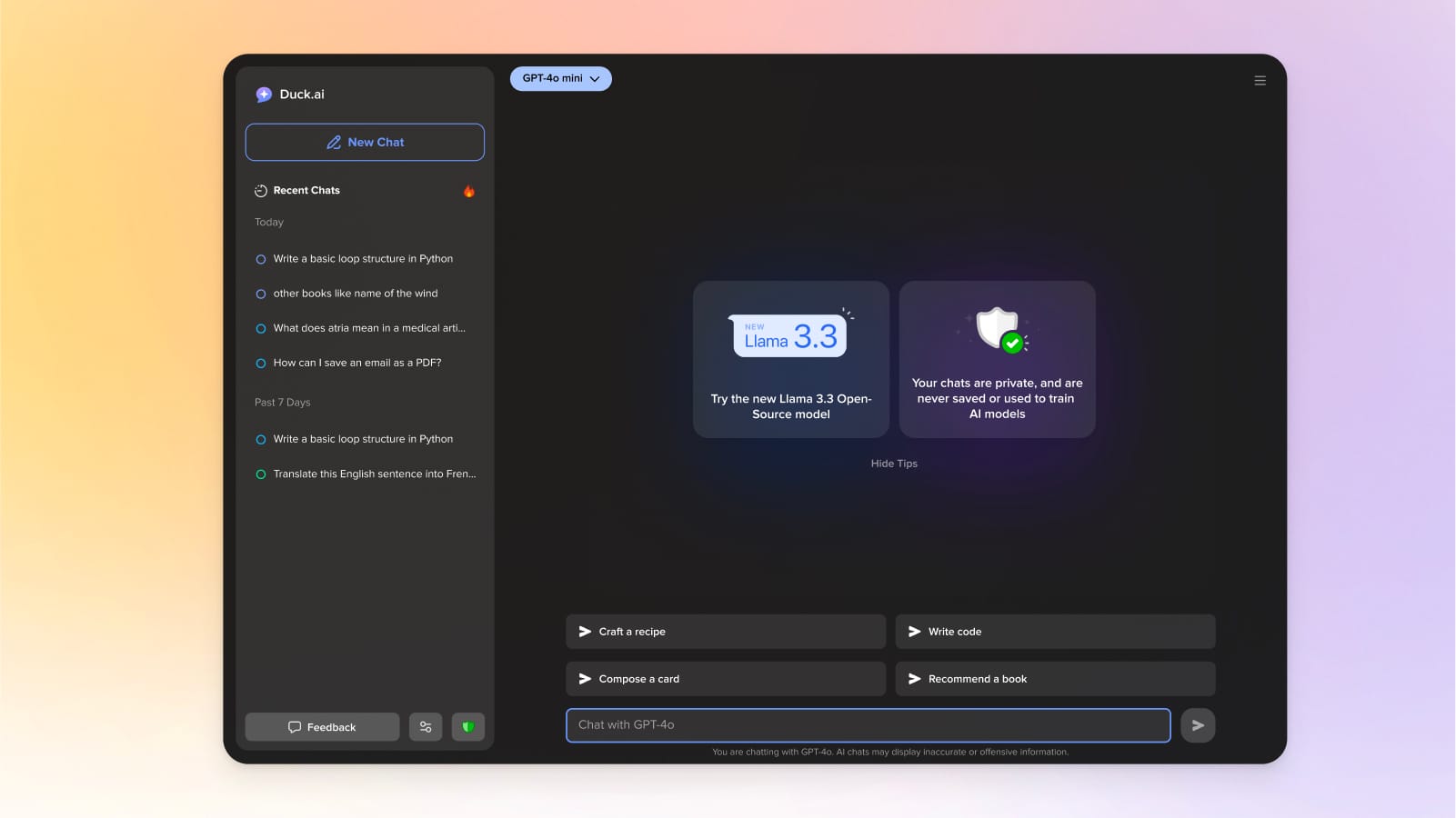
Head to Duck.ai for free, proxied access to popular chatbots from OpenAI, Anthropic, Meta, and Mistral.
A search engine’s core job is to get you the high-quality information you want fast. AI can help with that job, including a new mode of information-seeking through chat. We’re finding that some people prefer to start in chat mode and then jump into more traditional search results when needed, while others prefer the opposite. (Some questions just lend themselves more naturally to one mode or the other, too.) So, we thought the best thing to do was offer both. We made it easy to move between them, and we included an off switch for those who’d like to avoid AI altogether.
If you want to start with chat, try Duck.ai (previously called DuckDuckGo AI Chat), a free and account-less way to access popular AI chatbots, privately. Models are periodically updated and currently feature GPT-4o mini and o3-mini from OpenAI, open-source models Meta Llama 3.3 and Mistral Small 3, and Claude 3 Haiku from Anthropic. Chats are anonymized via proxying and never used for AI model training.
You can navigate directly to https://duck.ai/ or via the optional chat icons within our search engine or browsers. (There's also a widget - on iOS for now.) You can also use the !ai or !chat bang search commands from any browser where you have DuckDuckGo search set as the default search engine.
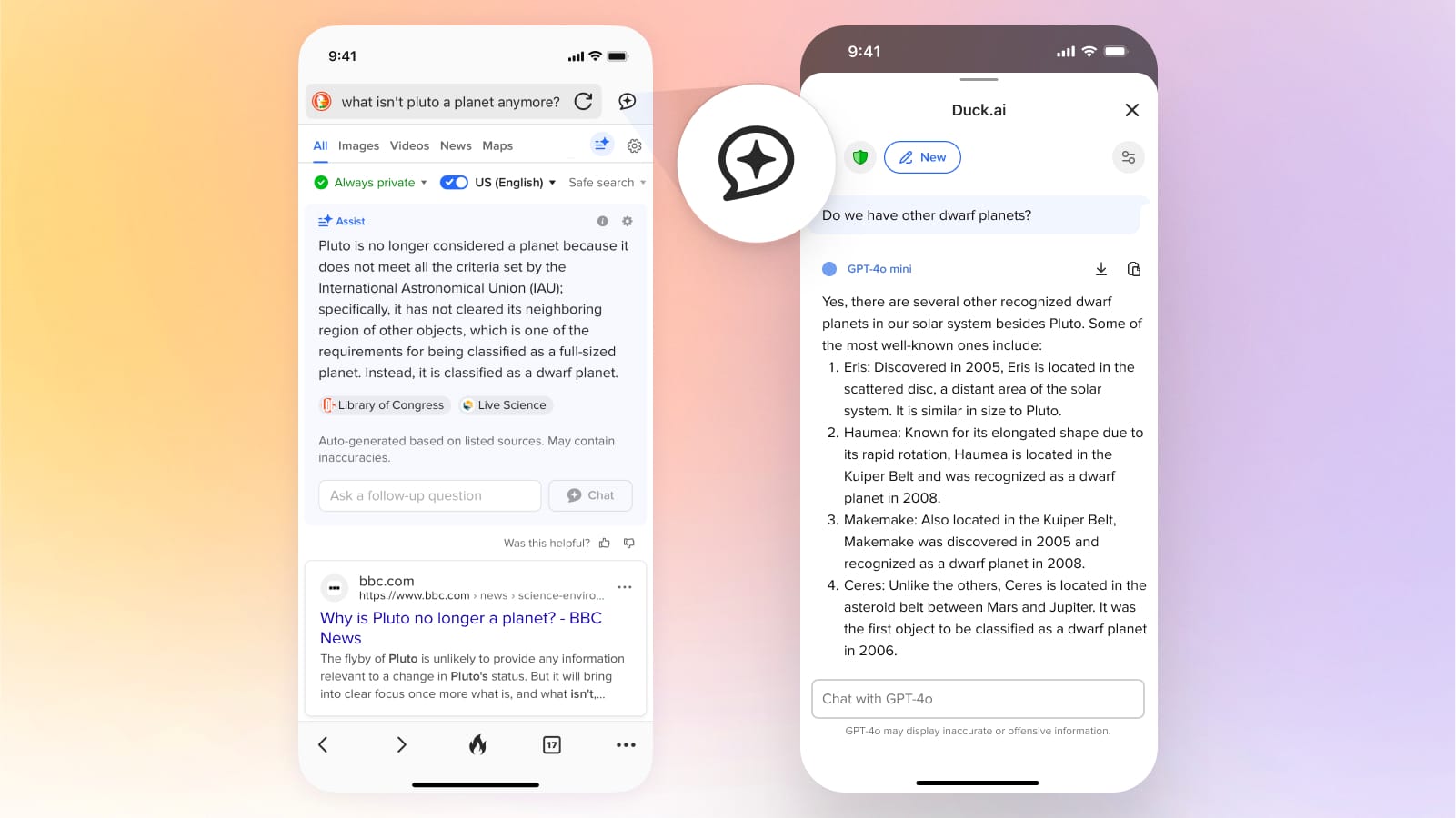
One way to access Duck.ai is via the Chat icons in our desktop and mobile browsers.
If you’d rather start with traditional search results, simply use DuckDuckGo search as usual. AI-assisted answers – previously called DuckAssist – will automatically appear on the search results page for relevant English language queries. You can also manually trigger an AI-assisted answer on demand by pressing the “Assist” button under the search box, which appears on most queries. The answers source information from across the web, and like Duck.ai, they are completely free and private, with no sign-up required.
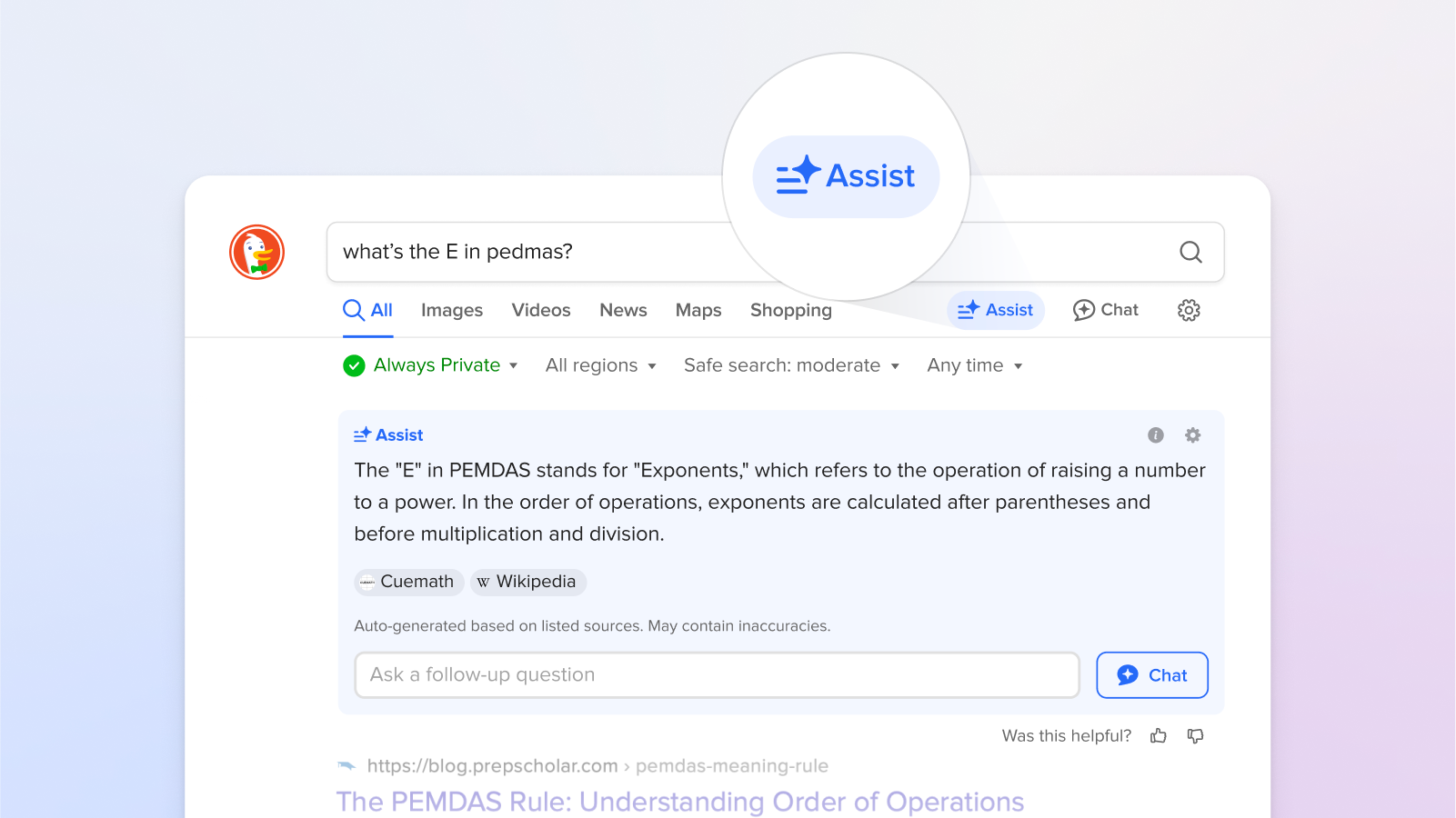
The “Assist” button lets you generate AI-assisted answers on demand.
We’ve continuously heard from users that they want more quick, at-a-glance answers, for a broad range of topics. For years, we’ve been doing that by working on search modules to provide instant answers for things like sports scores, local business information, where to watch movies and TV shows, and much more. Now, we are finding that we can significantly expand the scale of high-quality instant answers we can show with AI as we’re now serving millions of AI-assisted answers daily. Since we’ve introduced AI-assisted answers on our search results, overall user satisfaction with our search results has improved.
If you were unsatisfied after trying DuckDuckGo search in the past, now is a great time to try us again. We’re always improving. If you do try us or try us again, please set DuckDuckGo search as your default search engine or download our browser and make it the device default. It can take a moment to get used to something different, and setting the default is the best way to get over that hump.
How can I customize my search experience?
Navigate to the AI Features section of your search settings. If you really like our AI-assisted answers, change Assist to Often, which will make them appear over 20% of time. On the other hand, if you never want to see any AI features, turn Chat to Off and Assist to Never.
On DuckDuckGo browsers, you can choose whether the chat icon appears on the toolbar from within the ‘Duck.ai’ section in your browser settings.

Control how often you see AI-assisted answers from your search settings.
In addition to respecting our users’ choices, we respect publishers’ wishes to opt out of AI-assisted answers on DuckDuckGo and don’t penalize publishers for that choice. Even if they opt out as a source for our AI-assisted answers, they can stay opted into our other search results.
How am I protected?
When we generate AI-assisted answers, we anonymously call the underlying AI models used to summarize web sources on your behalf, so your personal information is never exposed to third parties. This method is called proxying. Duck.ai chats work similarly. To accomplish this technically, we remove your IP address completely and use our own IP address instead. This way, the proxied requests are coming from us, not you. For more information, please see the DuckDuckGo General Privacy Policy.
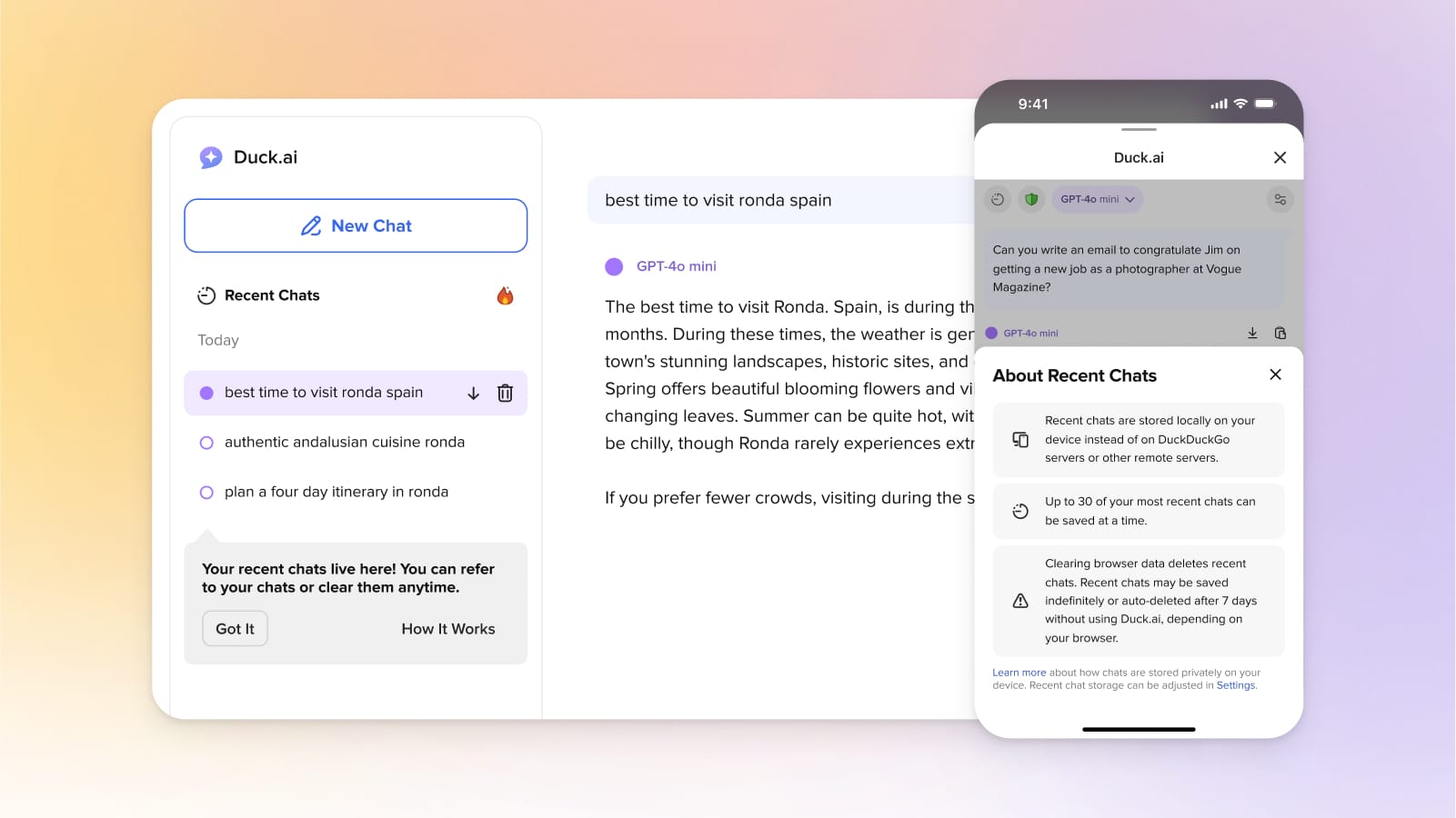
Duck.ai's "Recent Chats" let you pick up where you left off. Chats are saved locally on your device – not on DuckDuckGo or any other outside servers.
Within Duck.ai, recent chats are only stored locally on your device, not on DuckDuckGo servers. Not interested in storing your chats? You can disable the option altogether, or use the Fire Button to clear all your recent chats at once. Duck.ai chats are not used for any AI training, either by us or the underlying model providers. To respond with answers and ensure all systems are working, these providers may store chats temporarily, but we remove all the metadata so there’s no way for them to tie chats back to you personally. On top of that, we have agreements in place with all providers to ensure that any saved chats are completely deleted within 30 days. For more information, please see the DuckDuckGo AI Chat Privacy Policy and Terms of Use.
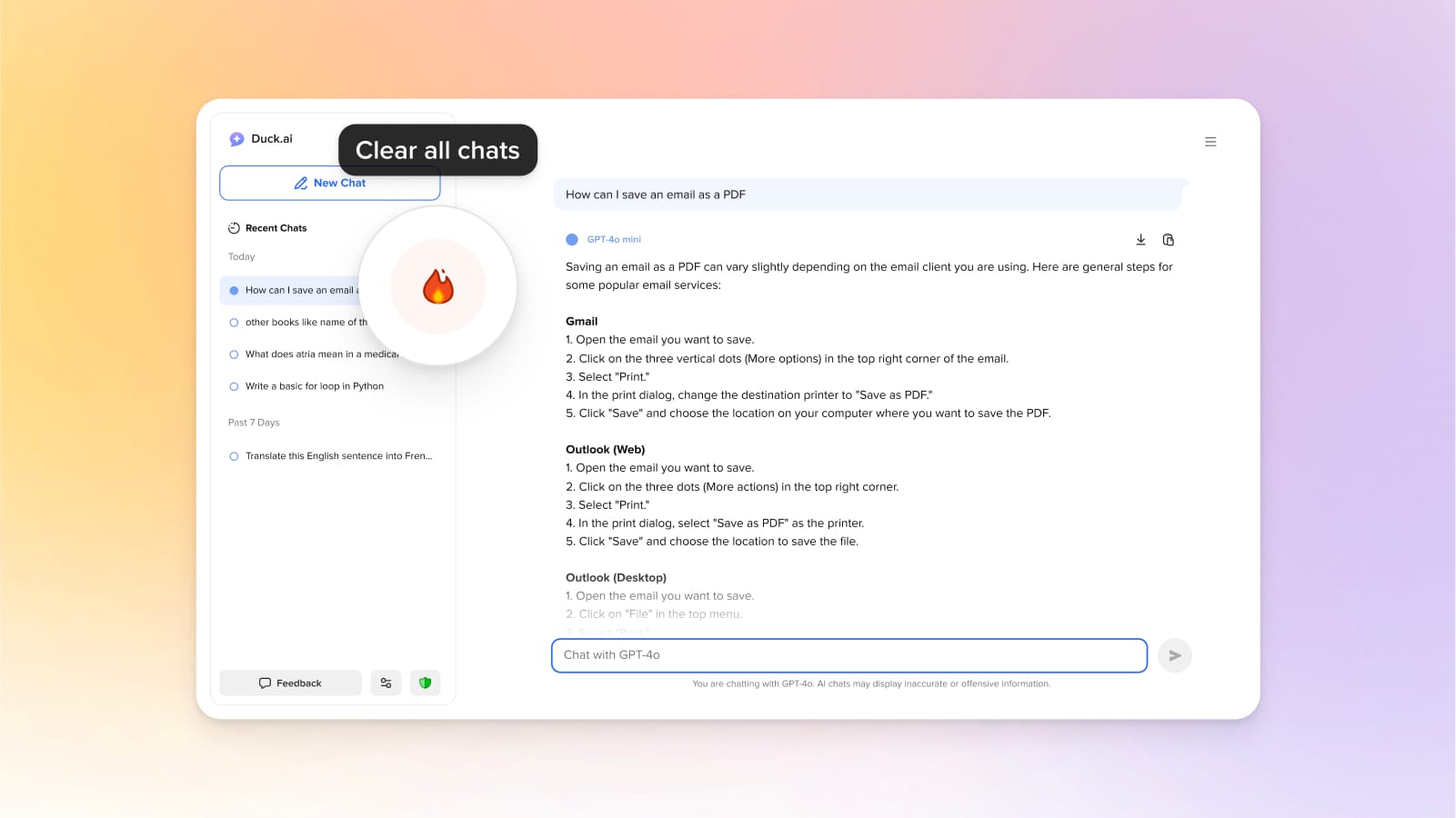
Clear your recent Duck.ai chats with the click of a button.
Are AI-assisted answers reliable?
When you search on DuckDuckGo, our AI-assisted answers are based on real-time web crawling, so they’re as reliable as the sources from which they are drawn. But even the most reliable sources can have errors, and mistakes can occasionally happen in the summarization process, too. That’s why we prominently display our cited sources: you can easily check them out and use your own judgment to make the final call.
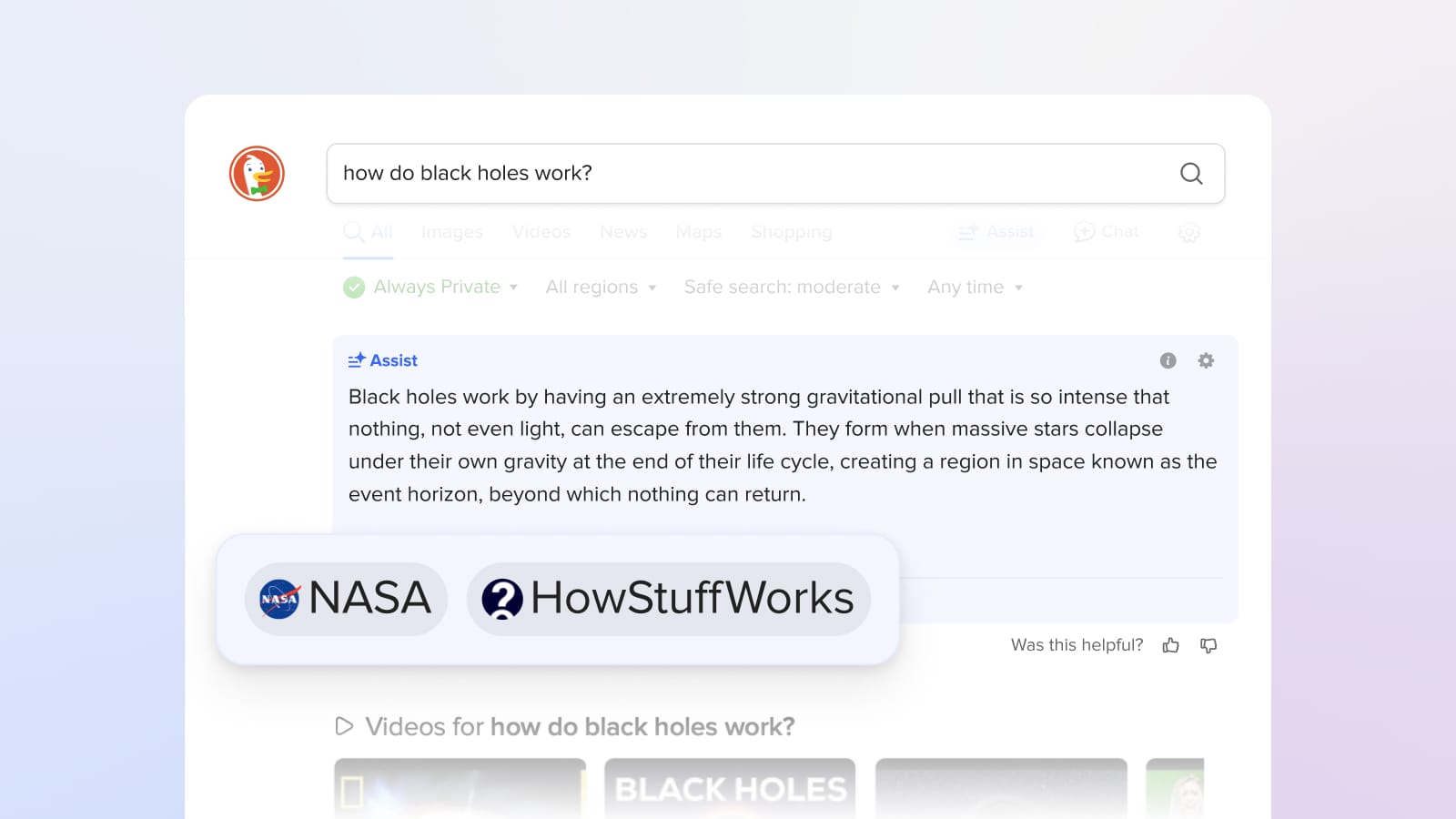
Want to know where your AI-assisted answer came from? Check the sources below the answer and click through for a deeper dive into complex topics.
We also have a number of precautions in place. Out of the countless websites we could draw from, we try to weed out ultra-low-quality sources like spammy content farms and invasive people search sites, and we try to avoid satirical sites and opinion pieces.
You are a critical part of the process as well. “Was this helpful? 👍 👎” is displayed next to every AI-assisted answer. So, if you see a bad answer – or a great answer! – please let us know. We review it all as part of our quality control process.
Is this really free?
Yes! AI-assisted answers are integrated into DuckDuckGo search, which is always free to use, with no log-in required. (We make money from private search ads.) Chatting on Duck.ai is also free within a daily limit, which we implement while maintaining strict user anonymity, just like we do for our search engine. We plan to keep the current level of access free; we’re exploring a paid plan for access to higher limits and more advanced (and costly) chat models.
What’s next?
We are largely driving our AI roadmap based on your feedback, so please keep it coming—we appreciate it. Within Duck.ai, this includes adding newer models, voice and image support, and granting models web access. For AI-assisted answers on our traditional search engine, we’re making them faster and more interactive, answering more queries, and improving when they appear automatically, including for less straightforward queries.
In the meantime, give Duck.ai a try and keep an eye out for AI-assisted in your traditional search results. Head to your search settings if you want to see them more or less often.
2024 DuckDuckGo Charitable Donations: $1.1M to support digital rights, online privacy, and a better Internet ecosystem
3 Dec 2024, 2:00 pm
2024 marks DuckDuckGo's 14th year of donations—our annual program to support organizations that share our vision of raising the standard of trust online. We are proud to donate to diverse group of organizations around the world that promote privacy, digital rights, access to information online, and a healthier online ecosystem.
This year, we’re donating $1,100,000, bringing DuckDuckGo's total donations since 2011 to $6,950,000. Everyone using the Internet deserves simple and accessible online protection; these organizations are all pushing to make that a reality. We encourage you to check out their valuable work below, alongside details about how our funds were allocated this year.
$100,000 to the Electronic Frontier Foundation (EFF)

“EFF's mission is to ensure that technology supports freedom, justice, and innovation for all people of the world.”
$75,000 to Public Knowledge
"Public Knowledge promotes freedom of expression, an open internet, and access to affordable communications tools and creative works. We work to shape policy on behalf of the public interest."
$50,000 to ARTICLE 19
"Established in 1987, ARTICLE 19 is an international non-profit organization that defends freedom of expression, fights against censorship, protects dissenting voices, and advocates against laws and practices that silence individuals, both online and offline."

$50,000 to Demand Progress
"DPEF educates our members and the general public about matters pertaining to the democratic nature of our nation’s communications infrastructure and governance structures, and the impacts of corporate power over our economy and democracy."
$50,000 to European Digital Rights (EDRi)
"The EDRi network is a dynamic and resilient collective of 50+ NGOs, as well as experts, advocates and academics working to defend and advance digital rights across Europe and beyond. For over two decades, it has served as the backbone of the digital rights movement and has achieved landmark successes in digital rights in Europe."
$50,000 to Fight for the Future

"Known for organizing some of the largest and most effective online campaigns in history, Fight for the Future’s mission is to ensure a just Internet and technology that is a force for empowerment and liberation, free of surveillance, censorship, and abuse of personal data."
$50,000 to The Markup
"The Markup challenges technology to serve the public good by producing investigative journalism, unique tools, and accessible resources to inspire action and agency."
$50,000 to OpenMedia

"OpenMedia is a community-driven organization that works to keep the Internet open, affordable, and surveillance-free. We operate as a civic engagement platform to educate, engage, and empower Internet users to advance digital rights around the world."
$50,000 to Restore the Fourth
“Restore the Fourth opposes mass government surveillance, and organizes locally and nationally to defend privacy and the Fourth Amendment.”
$50,000 to Signal

“Signal Technology Foundation protects free expression and enables secure global communication through open source privacy technology.”
$50,000 to the Surveillance Technology Oversight Project (S.T.O.P.)
“The Surveillance Technology Oversight Project (S.T.O.P.) advocates and litigates for privacy, working to abolish local governments’ systems of discriminatory mass surveillance."
$50,000 to Tech Policy Press
“Tech Policy Press promotes discussion, debate, and analysis of issues and ideas at the critical intersection of technology and democracy.”
$50,000 to the Tech Oversight Project
"Through engaging with lawmakers, exposing false narratives and bad actors, and pushing for landmark legislation, the Tech Oversight Project seeks to hold tech giants accountable for their anti-competitive, corrupting, and corrosive influence on our society and the levers of power."
$25,000 to Algorithmic Justice League (AJL)
“AJL’s harms reporting platform aims to capture people's lived experiences with AI harms, connect them with resources, and identify areas where there are no or few resources.”
$25,000 to Bits of Freedom

“Bits of Freedom shapes tech policy in order to facilitate an open and just society, in which people can hold power accountable and effectively question the status quo.”
$25,000 to the British Institute of International and Comparative Law (BIICL)
"The Competition Law Forum is a centre of excellence for European competition and antitrust policy and law at the British Institute of International and Comparative Law (BIICL)."
$25,000 to the Center for Critical Internet Inquiry (C2i2)

“UCLA Center for Critical Internet Inquiry (C2i2), housed in the UCLA Division of Social Sciences, is a critical internet studies community committed to reimagining technology, championing social justice, and strengthening human rights through research, culture, and public policy.”
$25,000 to Creative Commons (CC)
“Creative Commons (CC) is an international nonprofit organization dedicated to building and sustaining a thriving commons of shared knowledge and culture that serves the public interest.”
$25,000 to Digital Rights Watch

"Digital Rights Watch is Australia's leading digital rights organisation. They defend and promote privacy, democracy, fairness and fundamental rights in the digital age."
$25,000 to Gesellschaft für Freiheitsrechte (GFF)
"The Society for Civil Rights e.V. (Gesellschaft für Freiheitsrechte e.V. or "GFF") is a donor-funded organization from Germany that defends fundamental and human rights by legal means. The organization promotes democracy and civil society, protects against disproportionate surveillance and advocates for equal rights and social participation for everyone."
$25,000 to noyb
"noyb is committed to the legal enforcement of European data protection laws and has filed more than 850 cases against numerous intentional infringements by Big Tech companies - to make online privacy a reality for everyone."
$25,000 to the Open Home Foundation
“The Open Home Foundation fights for the fundamental principles of privacy, choice, and sustainability for smart homes - and for every person who lives in one. It is best known as the organization that owns and governs Home Assistant, among many other projects crucial to the open home."
$25,000 to the Open Rights Group (ORG)

"Open Rights Group is the UK’s largest grassroots digital rights campaigning organisation, working to protect everyone’s rights to privacy and free speech online."
$25,000 to the Open Source Technology Improvement Fund (OSTIF)
"Open Source Technology Improvement Fund helps critical open source projects with their security needs and is grateful for the continued support from DuckDuckGo. This funding is pivotal to ongoing operations, as it is one of our only donation sources that is not tied to any deliverable or project. Over the past year, OSTIF has been able to sustainably help critical open source projects improve their security posture, and in the process have found and fixed over 150 bugs and vulnerabilities."
$25,000 to Perl and Raku Foundation
"The Perl and Raku Foundation is a non-profit, 501(c)(3) which fulfills a range of activities including the collection and distribution of development grants, sponsorship and organization of community-led local and international Perl conferences, and support for community resources and user groups."
$25,000 to Privacy Rights Clearinghouse
"Privacy Rights Clearinghouse focuses on increasing access to information, policy discussions, and meaningful rights so that data privacy can be a reality for everyone."
$25,000 to Proof

"Proof is a new nonprofit journalism studio that is working to redefine and reimagine trustworthiness in news and investigative reporting."
$25,000 to the Tor Project
"At the Tor Project, we believe everyone should be able to explore the internet with privacy. We advance human rights and defend your privacy online through free, open source software and the decentralized Tor network."
Roadblocks to Competition: Investigate Google’s Non-Compliance with the EU’s Digital Markets Act
20 Nov 2024, 12:30 pm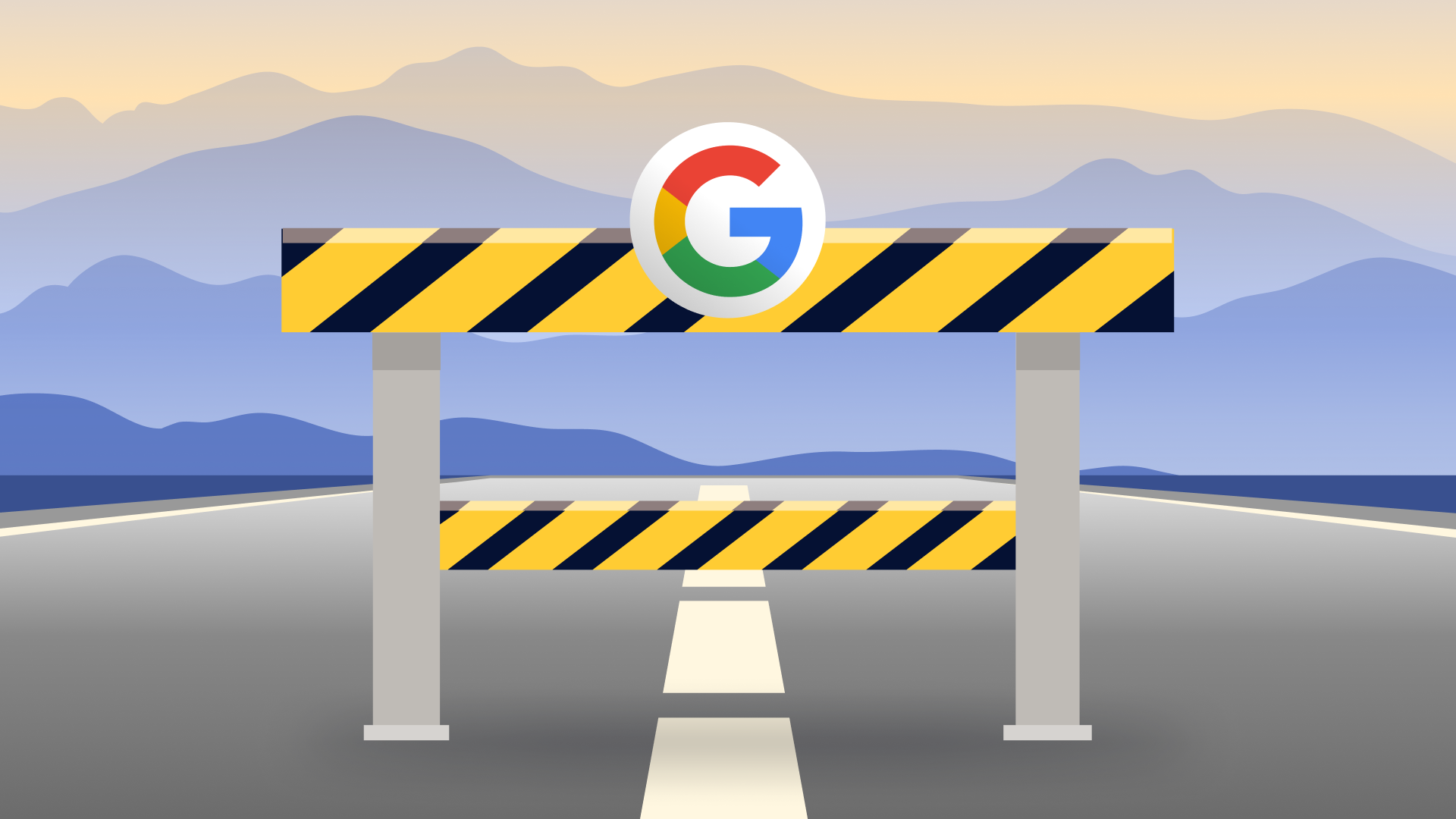
Today, we are calling on the European Commission to launch three non-compliance investigations around Google’s obligations under the EU’s Digital Markets Act (DMA):
- On Google’s non-compliance with Article 6(11), which requires Google to share anonymized click and query data.
- On Google’s non-compliance with Article 6(3), which requires Google to implement choice screens and enable end users to easily change default search settings.
- On Google’s non-compliance with Article 6(4), which requires any downloaded search or browser app to have the ability to prompt users to set search defaults easily.
The DMA created these obligations to address Google’s scale and distribution advantages, which the judge in the United States v. Google search case found to be illegal. The judge specifically highlighted that 70% of queries flow through search engine access points preloaded with Google, which creates a “perpetual scale and quality deficit” for rivals that locks in Google’s position.
Unfortunately, Google is using a malicious compliance playbook to undercut the DMA. Google has selectively adhered to certain obligations – often due to pressure from the Commission – while totally disregarding others or making farcical compliance proposals that could never have the desired impact. As a result, the DMA has yet to achieve its full potential, the search market in the EU has seen little movement, and we believe launching formal investigations is the only way to force Google into compliance. The Commission has already demonstrated its ability to use such investigations effectively under the DMA.
While Google’s bad faith approach is not surprising, it should not go unnoticed. Any regulator looking to create enduring competition in the search market should take note of the tactics Google is using to thwart and circumvent its legal obligations.
We project Google’s Click-and-Query data sharing proposal eliminates ~99% of search queries.
Google’s exclusive default distribution deals mean they see many times more search queries than any competitor can, which gives them what’s called a “scale advantage.” In Article 6(11), the DMA directly addresses this scale advantage by mandating Google share anonymized click, query, ranking, and view data. This data would help search engines improve results quality, especially for less frequent (so-called “long-tail”) queries.
Google’s Click-and-Query obligation under the DMA, Article 6(11), reads:
“The gatekeeper shall provide to any third-party undertaking providing online search engines, at its request, with access on fair, reasonable and non-discriminatory [FRAND] terms to ranking, query, click and view data in relation to free and paid search generated by end users on its online search engines. Any such query, click and view data that constitutes personal data shall be anonymised.”
To comply with this requirement, Google announced the “Google European Search Dataset Licensing Program.” However, this data set has little to no utility to competing search engines due, in large part, to Google’s proposed anonymization method, which only includes data from queries that have been searched more than 30 times in the last 13 months by 30 separate signed in users. This method is conveniently overbroad: we extrapolate that Google’s dataset would omit a staggering ~99% of search queries including “longtail” queries that are the most valuable to competitors. Google is trying to avoid its legal obligation in the name of privacy, which is ironic coming from the Internet’s biggest tracker.
Part of our goal at DuckDuckGo has always been to prove that tech can make great products without exploiting people’s data or using mass surveillance. Our Privacy Policy explains how we go about doing this, for example, “we have no way to create a history of your search queries.” We do this by stripping out any metadata that can tie searches together made by the same individual, so re-identification cannot happen like in the memorable AOL case. For example, we may know that we got a lot of searches for "cute cat pictures" today, but we don’t know - and have no way to figure out - who actually performed those searches.
The fact is that most "rare" queries are actually just common words put in an order that isn’t searched very often. These queries are not inherently problematic since they cannot be traced back to any individual. So, instead of attempting to filter all of these relatively unique queries, we should instead focus on removing the subset of those queries that contain personal identifiers, like addresses and phone numbers or accidental pastes like user ids and passwords. Fortunately, there are relatively straightforward approaches to remove these types of queries that will result in much of the long tail data remaining available to improve search results.
This isn’t even the only part of the proposal that severely hampers the usefulness of the data:
- The proposal averages ranking data, which eliminates critical nuances. It also doesn’t provide anonymous ranking signals like dwell time or bounce rate.
- The proposal shares at best three-month old data, meaning the data is already stale when received because many results would no longer reflect current search trends.
- The proposal contains hardly any information on search modules, such as knowledge panel content, meaning information on much of the content on the search result page is not being shared.
We recognize that fine-tuning the right approach requires further considerations and, most importantly, testing and good faith cooperation from Google. Faced with Google’s continued obstruction, we believe that opening an official investigation is the only way to arrive at a workable proposal. We would like to help in that effort and believe there are ways for Google to provide a data set that is both privacy respecting and useful to competitors.
Google has so far completely ignored “easy switching” requirements.
The DMA includes provisions designed to facilitate easy switching of search engines and browsers, targeting Google’s entrenched hold over search and browser access points. Google’s obligation under Article 6(3) of the DMA reads:
“The gatekeeper shall allow and technically enable end users to easily change default settings on the operating system, virtual assistant and web browser of the gatekeeper.”
Despite this obligation, switching search engines on Android devices (which make up more than 60% of the mobile market in the EU) is still not “easy.” Before the DMA came into effect, it took more than 15 steps to switch your default search engine on Android and today that is still the case.
Zero changes have been made. What should happen is that users should be able to change their default search engine across every search access point in one click, similar to how a choice screen works, but currently choice screens are only shown on device onboarding. Users should be able to get back to a similar screen via a top-level device setting for default search, which we should be also able to guide users to directly from our app.
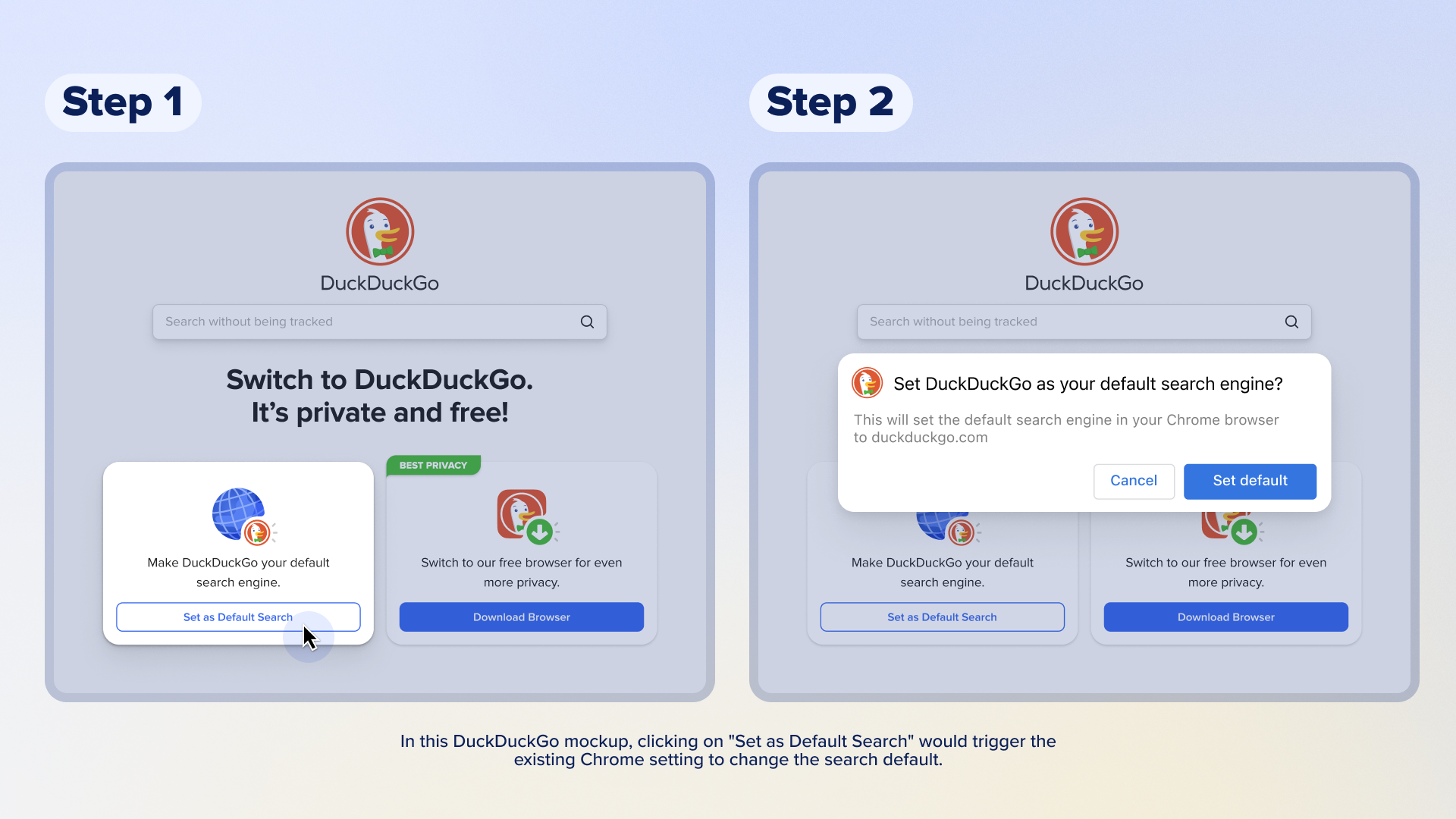
Similarly on Chrome, switching the default search engine has not been made any easier either. For example, there’s still no way to guide a user directly to the default search engine setting from the DuckDuckGo search homepage. And Google’s persistent dark pattern for search extensions on Chrome remains.
Google has completely ignored its easy switching obligations under the DMA. As a result, we believe the Commission must launch a non-compliance investigation to get Google to fulfill its requirements under the law. “Easy switching” should mean competition is actually one click away.
Google still hasn’t rolled out its updated Android choice screens to 250+ million EU Android users.
Article 6(3) DMA requires Google to show choice screens to end users “at the moment of the end users’ first use of an online search engine or web browser.”
Google’s search engine DMA choice screen is explicitly different from the choice screen Google implemented following the Android case. Key improvements have been made to its design, such as automatically showing taglines. But Google has not rolled out this updated DMA choice screen to all Android users, in breach of Article 6(3). Apple, for example, rolled out its DMA browser choice screen to its entire EEA user base and is planning to do so again after an investigation from the Commission – this time to Safari default users only.
A non-compliance investigation must therefore be opened to ensure that Google will fulfill its obligation and roll out both the DMA search engine and browser choice screens to all Android devices at once like they did on Chrome for desktop and iOS. When those Chrome choice screens rolled out, the positive competitive impact was evident: DuckDuckGo search queries on Chrome have increased by around 75% across the EEA. This rapid and stable growth in query volume shows pent-up demand by Chrome users for privacy-respecting search alternatives.
What can regulators learn from this?
Regulators around the world should be looking at what’s happening with the DMA, learn from how Google has been able to exploit its loopholes and circumvent it, and then take steps to make sure Google cannot continue to put up roadblocks in the way of progress and fair competition.
In the EU, Google chose to roll out self-serving compliance proposals around these obligations without engaging in meaningful consultations, leading to significant delays in achieving contestability and fairness, the objectives of the DMA. Given the opportunity, it should not come as a surprise that Google is taking advantage.
Instead, regulators and market participants should be able to review, test, and validate remedies before they are implemented to ensure they actually accomplish their intended purpose, while maintaining the regulatory authority to launch investigations and make changes after implementation, if necessary. Regulators can set additional criteria to make sure these interventions have the desired impact. For example, dominant firms could be required to demonstrate that consumers understand how to switch and that switching to a competitor is equivalently easy to sticking with the services from the dominant firm.
In addition, we believe the DMA doesn’t properly address Google’s scale advantage. Sharing click-and-query data is a critical intervention to address Google’s scale advantage, but alone, it isn’t sufficient to create a competitive search engine. As we’ve previously written, we believe the best and fastest way to level the playing field on search quality is for Google to provide access to its search results via real-time APIs (Application Programming Interfaces), also on FRAND (Fair, Reasonable, and Non-Discriminatory) terms. That means for any query that could go in a search engine, a competitor would have access to the same search results.
If Google is required to license its search results in this manner, this would allow existing search engines and potential market entrants to build on top of Google’s various modules and indexes, and offer consumers more competitive and innovative alternatives. In addition, while choice screens are an excellent mechanism to provide consumers access to competitors, they need to be shown periodically, at least yearly, to give competing search engines a chance to build awareness over time. We are happy to work with regulators to craft remedies that will create enduring search competition.
Investing in privacy-respecting companies that are raising the standard of trust online
23 Oct 2024, 11:50 am
At DuckDuckGo, we know what it's like to turn a vision into a successful company. Our founder and CEO, Gabriel Weinberg, began DuckDuckGo’s journey to “raise the standard of trust online” from his basement in Pennsylvania and turned it into a browser and search engine used by millions of people around the world.
Today, this vision still inspires us. Each year, we donate to non-profit organizations that align with this vision, and now we're investing in companies that align with it as well.
As more and more consumers seek privacy-conscious technologies, we want to partner with other like-minded entrepreneurs and help turn their visions into reality. With the core objective of supporting consumer privacy technologies, DuckDuckGo is actively investing in early-stage companies as well as pursuing acquisitions and partnerships. We've actually already been doing this quietly for the last couple years, and we’re energized to do more. So, we'd love to hear from you and find ways to work together.
We are focused primarily on three domains:
- Search and browse: It's the core of our product and where we continue to invest most heavily.
- Consumer privacy technologies: This spring, we launched Privacy Pro, a 3-in-1 subscription service with VPN, Personal Information Removal, and Identity Theft Restoration. Our acquisition of Removaly was key to accelerating the development of our Personal Information Removal solution. We continue to look for other complementary technologies that could extend our offerings.
- Emerging technologies: We recently announced DuckDuckGo AI Chat, which offers private access to popular AI chatbots. We’re committed to investing in this emerging technology space and others, but only in ways that are privacy-respecting.
For early-stage investments, we are flexible on deal structure, aim to move quickly and are happy to co-invest with other companies, funds, and individuals. For acquisitions, we are open to a range of companies that share a commitment to protecting user privacy.
You can reach Mike Marino, SVP of Finance and Diana Chiu, Director of Corporate & Business Development directly at investments@duckduckgo.com.
Creating Enduring Competition in the Search Market
12 Sep 2024, 12:39 pm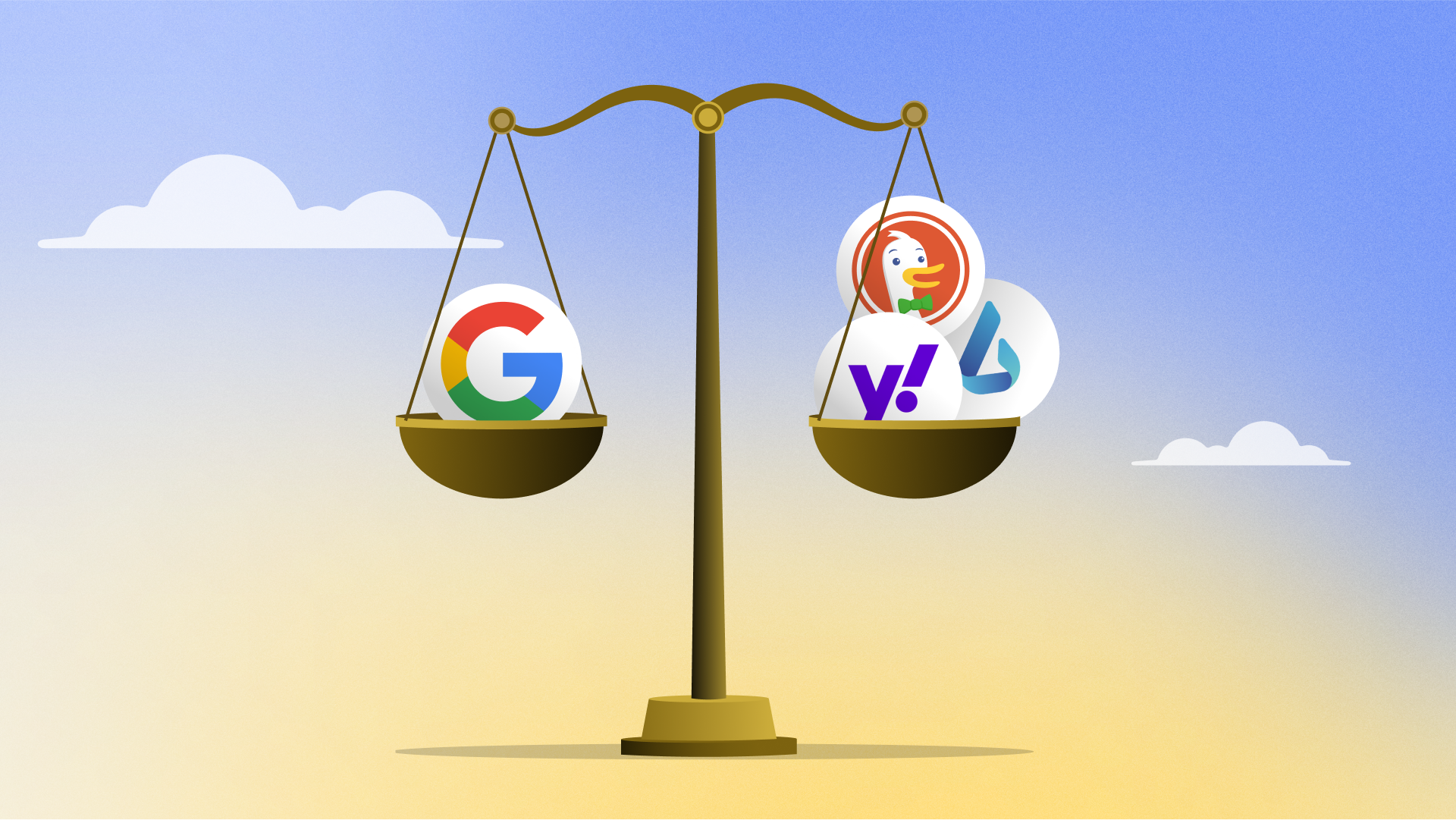
Since the ruling in the U.S. v. Google search case was announced, there has been discussion about how to remedy Google’s dominance. As a company that operates a search engine that directly competes with Google, we have several ideas about how to craft a set of legal and technical interventions that can, in combination, effectively curb the advantages Google has gained through illegal use of their search monopoly. DuckDuckGo believes it is possible to put remedies in place that will establish enduring search competition, encourage innovation and new market entrants, and result in significant market share among multiple competitors.
However, there is no silver bullet remedy that, alone, will adequately address both Google’s scale and distribution advantage as well as ensure that Google cannot circumvent its obligations. Instead, the “remedy” must be a package of remedies that work together to effectively counteract the unlawful competitive imbalance.
Counteracting Google’s Scale Advantage with Access to Search Results
Many ideas on the table aim to counteract Google’s distribution advantage, but we believe it’s equally important to address Google’s scale advantage. Google’s exclusive default distribution deals mean they see way more queries than everyone else, a.k.a. their scale advantage. The court’s opinion quantifies this disparity:
More users mean more advertisers, and more advertisers mean more revenues…. Google’s scale means that it not only sees more queries than its rivals, but also more unique queries, known as “long-tail queries.” To illustrate the point, Dr. Whinston analyzed 3.7 million unique query phrases on Google and Bing, showing that 93% of unique phrases were only seen by Google versus 4.8% seen only by Bing.
Google uses this stream of information to continuously improve their results by running large-scale experiments in ways that no rival can because we’re effectively blinded. Google infers the best results based on queries it has seen before. If a search engine sees fewer – or often zero – similar queries, these inferences are less effective.
As the court describes the situation, Google’s scale advantage fuels a powerful feedback loop of different network effects that ensure a “perpetual scale and quality deficit” for rivals that locks in Google’s advantage.
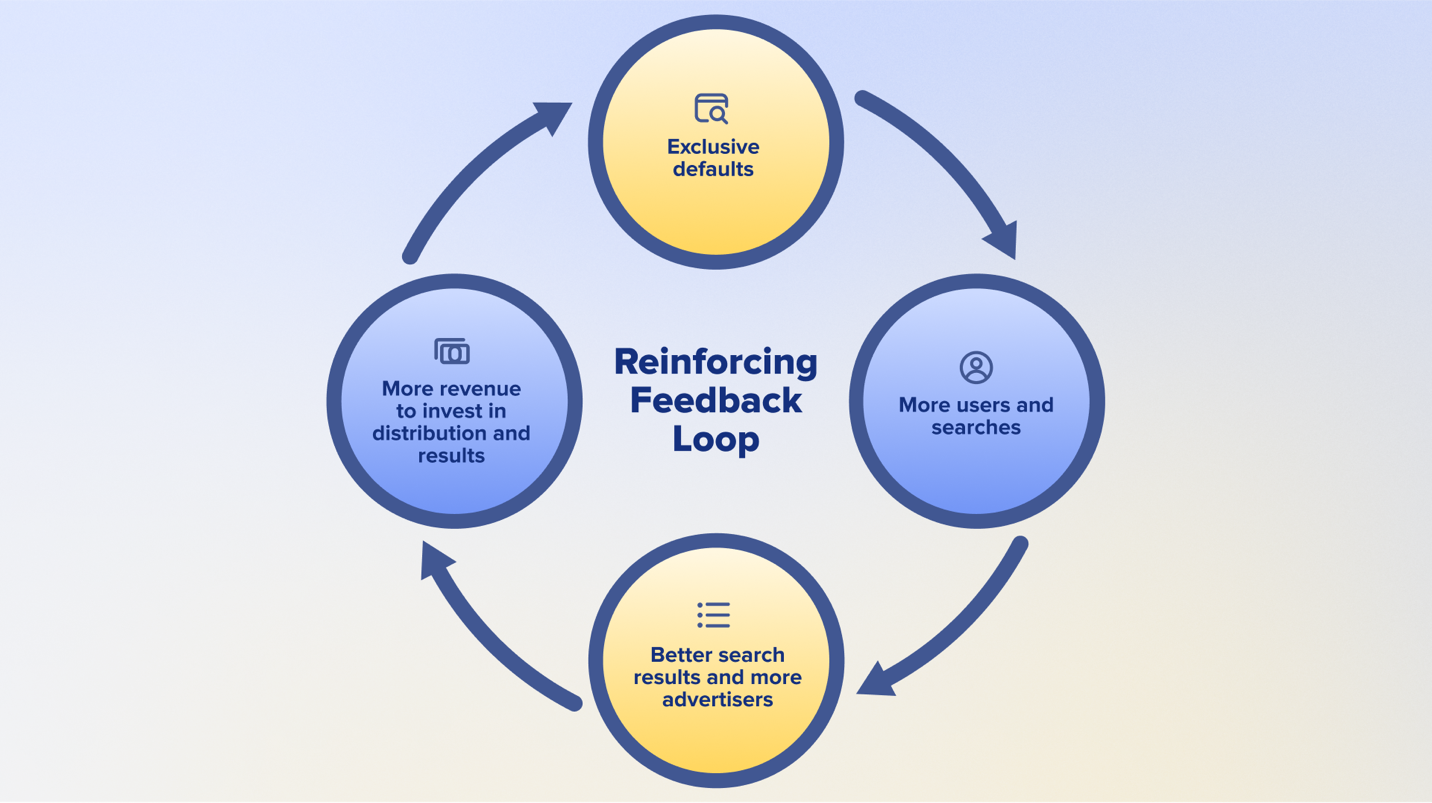
Google’s exclusive defaults are part of a reinforcing feedback loop that gives them an insurmountable scale advantage and makes it difficult for rivals to compete.
The best and fastest way to level this playing field is for Google to provide access to its search results via real-time APIs (Application Programming Interfaces) on fair, reasonable, and non-discriminatory (FRAND) terms. That means for any query that could go in a search engine, a competitor would have access to the same search results: everything that Google would serve on their own search results page in response to that query. If Google is forced to license its search results in this manner, this would allow existing search engines and potential market entrants to build on top of Google’s various modules and indexes and offer consumers more competitive and innovative alternatives.
Today, we believe that we already offer a compelling search alternative with more privacy and fewer ads, relative to Google. We’ve also been working for fifteen years to make our search results on par in terms of feature set and quality by combining our own search indexes with those of partners like Apple, Microsoft, TripAdvisor, Wikipedia, and Yelp. However, we know that many consumers still prefer Google’s results due to the benefits of scale discussed above, and this intervention would erase that advantage, instantly making us and others much more competitive.
We’ve already seen some concerns about this remedy direction that we’d like to quickly address. First, licensing Google’s search results does not involve accessing any user data. This remedy will not invade user’s privacy, which is aligned with our vision as a company. We know from experience that this remedy can be implemented anonymously, and we can advise on that implementation. We can open up Google without opening up user data.
A second potential concern is that long-tail results on leading search engines could be similar in some cases, but that’s a feature not a bug. Google’s scale advantage gives them insights into which obscure links should be ranked higher, and so we should expect that when smaller search engines incorporate this information that some results would become more similar. However, licensing on FRAND terms should also allow competitor search engines to re-rank and mix results with other content, which will enable competitor search engines to produce different ranking algorithms based on the same underlying high-quality search results.
Additionally, FRAND licensing will allow other search engines to more competitively differentiate on things like privacy, design, and customization of the user interface and results page, while still providing high-quality results. For example, we can envision a universe of differentiated and innovative experiences, such as features that allow users to tweak ranking algorithms, features that bring more transparency to ranking algorithms, and other AI capabilities, all leveraging Google’s search result APIs. Future-looking use cases like these must be kept in mind, and FRAND API access is what is needed to power these types of search innovations.
A third concern is that competitor indexes could become too reliant on Google; however, if all the results that come through the APIs can also be used as an input into building search indexes, this would ensure that there is also a path to long term viability and independence for competitors. We, for one, would go further down this path. This could be accelerated if the APIs also provide access to Google’s anonymous ranking signals (for example, how often and quickly people in aggregate click back after visiting a link), which will help tune competitor indexes even faster as well as improve real-time reranking algorithms. That said, we recognize that licensing Google’s search results needs to be a long-term intervention because their scale advantage will persist as long as Google has much more significant market share than competitors.
There are historical precedents for this type of remedy as well. AT&T’s 1956 antitrust agreement required the company to license its patents on FRAND terms, which allowed existing and new companies to build on top of AT&T’s innovations. Similarly, the Telecommunications Act of 1996 encouraged competition in communications markets by requiring large telecommunications providers to interconnect their networks with new competitors on FRAND terms.
This is not a new technical challenge for Google either: Google already licenses their search results, including their ads, via real-time APIs to some competitors. It’s also not novel in antitrust, as API access was at stake in Microsoft’s antitrust settlement two decades ago. An API-based remedy also means that startups could immediately enter the search market rather than be forced to invest tens or hundreds of millions of dollars upfront to get started by acquiring and consuming massive data sets. It also protects nascent competition in AI-driven search by allowing them to use the APIs to ground answers in real-time.
Finally, we should note that the EU’s Digital Markets Act attempts to solve Google’s scale advantage by requiring Google to provide FRAND access to its “click and query data.” To date, this has been ineffective because Google has undermined the requirement by limiting the data they share to the point of being useless. However, while we believe that click and query data is not a substitute for FRAND access to search result APIs, we also believe that if implemented correctly it can complement and further accelerate the path to competitor independence. That’s because API access will be limited to queries a competitor search engine actually sees, whereas click and query data can be much broader, covering almost all the queries Google sees. Therefore, access to this data in a privacy-protective manner should also be given on FRAND terms.
Counteracting Google’s Distribution Advantage with a Ban on Self-Preferencing in Chrome and Android
Google likes to claim everyone chooses Google, but most consumers don’t: they just go with the default. The court outlines how staggering this default advantage is:
50% of all queries in the United States are run through the default search access points covered by the challenged distribution agreements…. An additional 20% of all searches nationwide are derived from user-downloaded Chrome, a market reality that compounds the effect of the default search agreements. That means only 30% of all [general search engine] queries in the United States come through a search access point that is not preloaded with Google. Additionally, default placements drive significant traffic to Google. Over 65% of searches on all Apple devices go through the Safari default. On Android, 80% of all queries flow through a search access point that defaults to Google.
The court also consolidates evidence highlighting that large percentages of consumers don’t even realize they are using Google because of these defaults:
- An internal Google email in 2016 acknowledged that “users on Edge don’t even realize they aren’t using Google.”
- A 2018 Google study revealed there was “substantial user confusion regarding which browser and [general search engine] was in use.”
- A 2020 Google study found that over 50% of U.S. iPhone users were “unsure” what search engine powered Safari, concluding users are “often unaware they’re using Google.”
Users are confused and competition is crushed. As a result, Google shouldn’t be able to self-preference its search engine on Chrome and Android, which were developed to expand the reach of Google Search. Within these products, there should be no preset search default. Instead, these platforms need user-friendly settings based on sound principles that provide for:
- Regular access to well-designed choice screens that put users in charge of choosing their search engine default when setting up Android or Chrome, and periodically thereafter. Choice screens should set the search engine across all search access points on Android and Chrome.
- An easy way for users to navigate back to these settings.
- A one-click mechanism for any rival search engine to switch these settings and offer itself as a default search engine when users visit their website or app.
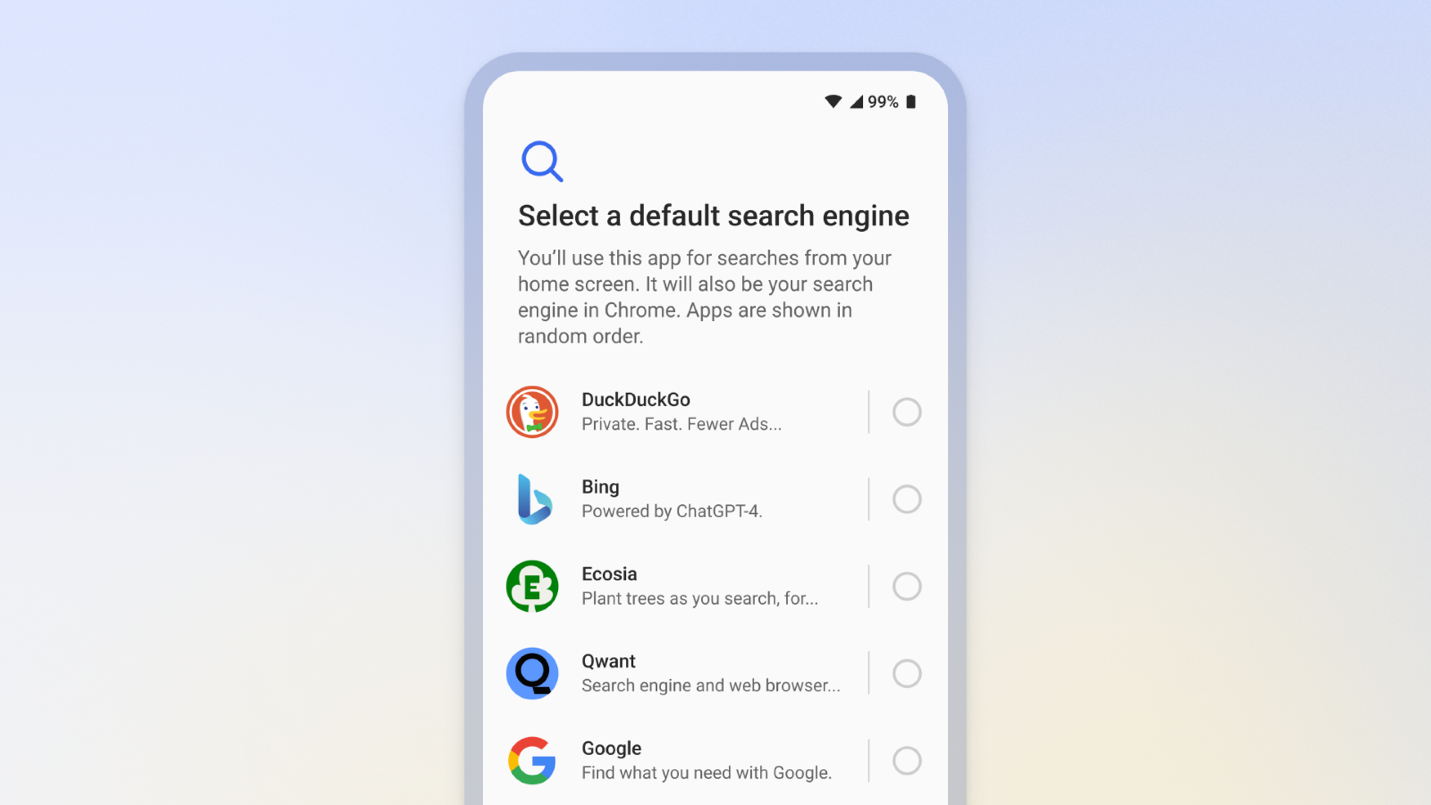
Image of the search engine choice screen on Android in the EU.
Banning self-preferencing must also include a prohibition on dark patterns, and all remedies must be subject to anti-circumvention provisions. For example, these restrictions should prohibit Google from discouraging users from installing rival apps or search extensions, or encouraging them to switch back to Google.
Unfortunately, a self-preferencing ban won’t create enduring competition by itself. However, as rivals can innovate on top of Google’s search results, and consumers become aware of rival brands and their increased quality, this increased access to consumers will accelerate competition in the search market.
Counteracting Google’s Distribution Advantage by Restricting Exclusionary Contracts
The court has already declared Google’s exclusionary contracts unlawful. While there are methods outside of these exclusive defaults to access search engines, the court recognizes that these “channels are far less effective at reaching users. That is due in part to users’ lack of awareness of these options and the ‘choice friction’ required to reach these alternatives.”
Restricting these exclusive agreements is therefore essential to help open up access to the search market. However, just restructuring these contracts by itself won’t do much because it won’t directly counteract Google’s entrenched advantage. For that, we need to look to the remedies discussed above.
On Accountability
Even the most well-crafted remedies will ultimately fail if Google is in charge of designing and implementing them, as has been the case in the EU. We’ve seen firsthand how Google has easily and repeatedly avoided complying with both the letter and the spirit of the law. Consequently, an independent monitoring body made up of technical experts and affected market participants must be fully empowered to keep Google honest. We should expect that this monitoring entity will need to be in place for as long as the remedies are in place. We cannot let the fox guard the henhouse.
On Structural Remedies
We are not opposed to structural remedies, but they would need to be paired with the additional interventions outlined in this post. In other words, structural changes to Google could theoretically be an accelerant in some circumstances, but regardless are not a replacement for FRAND access to search results and click and query data together with a ban on Google-self preferencing and a restriction on exclusive contracts. And we can envision some scenarios where a particular structural remedy could be more harmful to us than helpful.
A Long Road Ahead
Counteracting the entrenched competitive imbalance that Google’s default advantage has afforded them will not happen overnight. Realistically, it will take years for competition to take hold, and a fully-funded and motivated Department of Justice will need to be involved for the long haul. However, we are confident that a package of well-implemented and carefully monitored remedies, each designed to address a specific choke point, can work to create enduring competition in the search market.
DuckDuckGo AI Chat: anonymous access to popular AI chatbots
6 Jun 2024, 11:36 am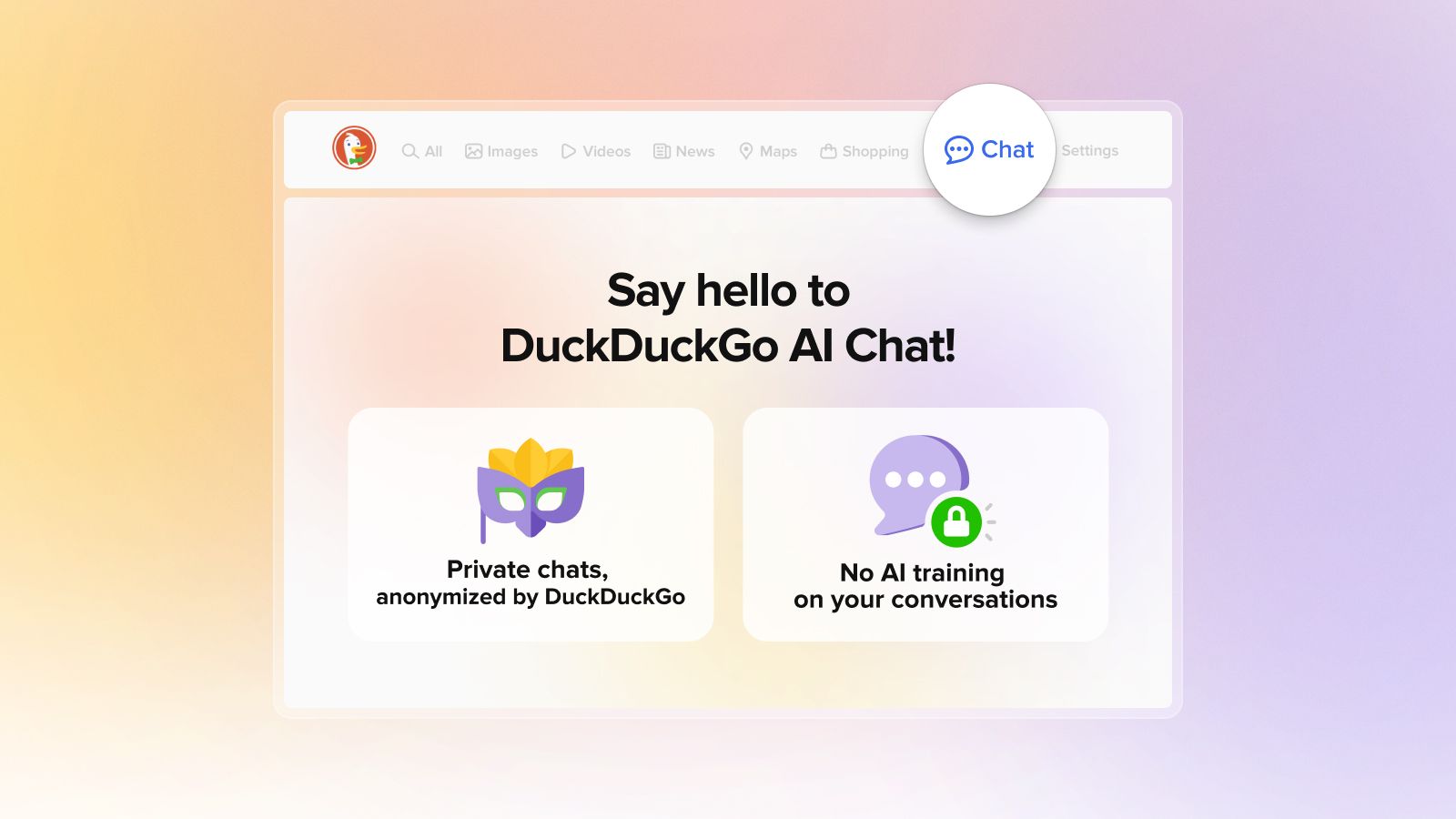
DuckDuckGo AI Chat is an anonymous way to access popular AI chatbots – currently, Open AI's GPT 3.5 Turbo, Anthropic's Claude 3 Haiku, and two open-source models (Meta Llama 3 and Mistral's Mixtral 8x7B), with more to come. This optional feature is free to use within a daily limit, and can easily be switched off.
- Chats are private, anonymized by us, and not used for any AI model training.
- Find DuckDuckGo AI Chat at duck.ai, duckduckgo.com/chat, on your search results page under the Chat tab, or via the !ai and !chat bang shortcuts. They all take you to the same place.
- Improvements are already on the way. Our roadmap includes adding more chat models and browser entry points. We’re also exploring a paid plan for access to higher daily usage limits and more advanced models.
Why did you make AI Chat?
Find AI Chat on your search results page for easy switching between the two.
Our mission is to show the world that protecting your privacy online can be easy. We believe people should be able to use the Internet and other digital tools without feeling like they need to sacrifice their privacy in the process. So, we meet people where they are, developing products that add a layer of privacy to the everyday things they do online. That’s been our approach across the board – first with search, then browsing, email, and now with generative AI via AI Chat.
DuckDuckGo AI Chat is a free, anonymous way to access popular AI chatbots. According to recent Pew reporting, adults in the U.S. have a negative view of AI's impact on privacy, even as they're feeling more positive about AI's potential impact in other areas. "About eight-in-ten of those familiar with AI say its use by companies will lead to people’s personal information being used in ways they won’t be comfortable with (81%) or that weren’t originally intended (80%)." Even so, another recent report shows a steady uptick in the share of U.S. adults who are using chatbots for work, education, and entertainment. If you're interested in AI chatbots but share those privacy concerns, DuckDuckGo AI Chat is for you.
In the industry-wide race to integrate generative AI, there’s a lot of pressure to add AI features just for the sake of saying you have them. We’re taking a different approach. Before adding any AI-assisted features to our products – first DuckAssist, our AI-enhanced Instant Answer, and now AI Chat – we think carefully about how to make them additive to the search and browse experience, and we roll them out cautiously to ensure this is the case. We also recognize these features aren’t for everyone, so we’ve made our AI-assisted features totally optional; if you’re not interested, you can easily switch them all off.
We view AI Chat and search as two different but powerful tools to help you find what you’re looking for – especially when you’re exploring a new topic. You might be shopping or doing research for a project and are unsure how to get started. In situations like these, either AI Chat or Search could be good starting points. If you start by asking a few questions in AI Chat, the answers may inspire traditional searches to track down reviews, prices, or other primary sources. If you start with Search, you may want to switch to AI Chat for follow-up queries to help make sense of what you’ve read, or for quick, direct answers to new questions that weren’t covered in the web pages you saw. It’s all down to your personal preference. That’s on top of AI Chat’s unique generative capabilities, like drafting emails, writing code, creating travel itineraries, and much more.
Since it can be useful to switch back and forth, we’ve made AI Chat accessible through DuckDuckGo Private Search for quick access: after you make a search, just click on the Chat tab underneath the search bar to keep exploring the topic. You can also get to AI Chat directly by navigating to duck.ai or duckduckgo.com/chat; from there, it’s easy to jump back into traditional search using the top navigation.
How does it work … and how is it private?
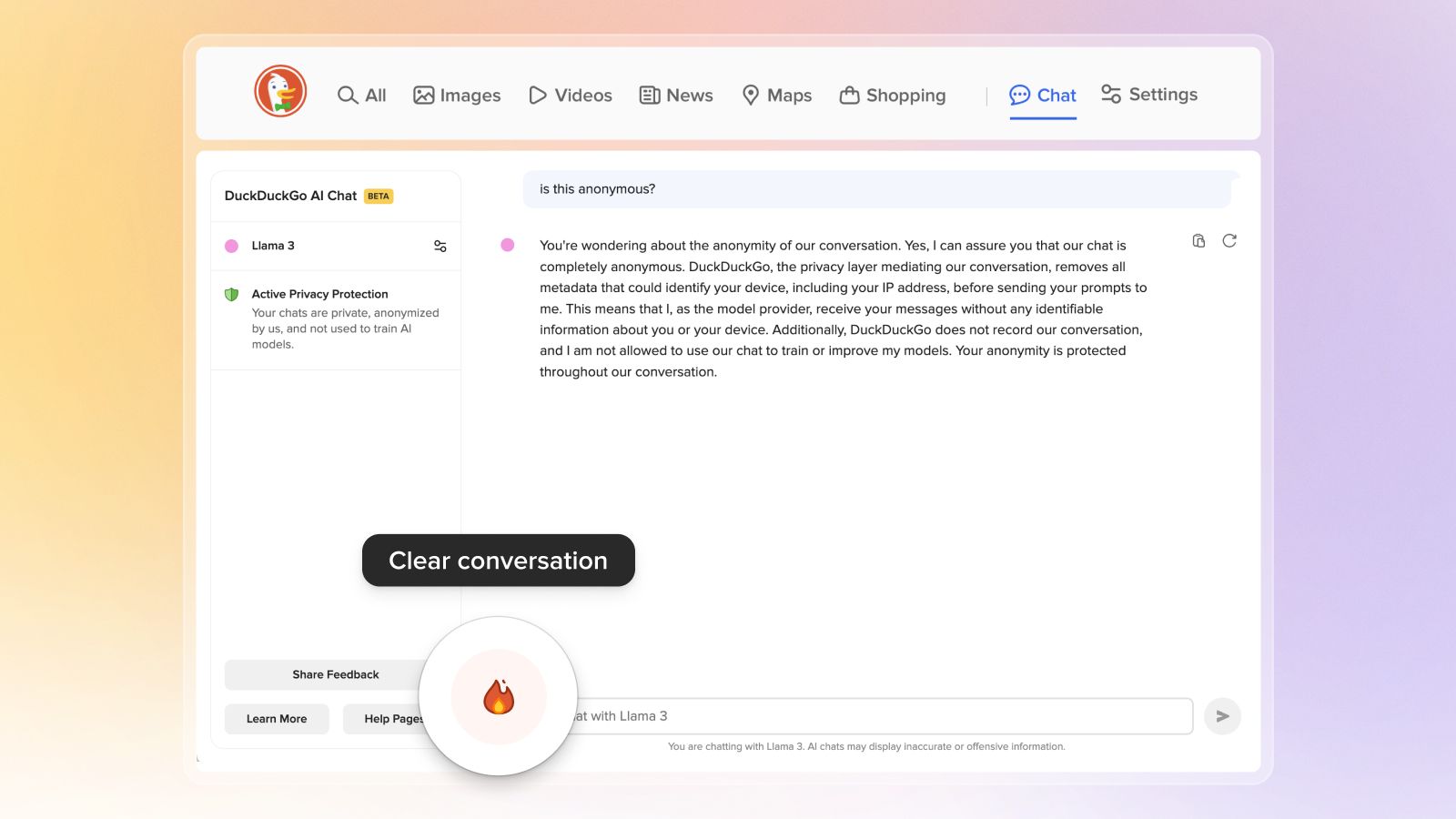
AI Chat is always anonymous. Want to start over? Hit the Fire Button to delete your current conversation.
When you land on the AI Chat page, you can pick your chat model – currently, OpenAI’s GPT 3.5 Turbo, Anthropic’s latest generation Claude 3 Haiku, and open-source options Mixtral 8x7B and Meta Llama 3 – and start using it just like any other chat interface. Just like searches on DuckDuckGo, all chats are completely anonymous: they cannot be traced back to any one individual. To accomplish that technically, we call the underlying chat models on your behalf, removing your IP address completely and using our IP address instead. This way it looks like the requests are coming from us and not you. Within AI Chat, you can use the Fire Button to clear the chat and start over.
In addition, DuckDuckGo does not save or store any chats. To respond with answers and ensure all systems are working, the underlying model providers may store chats temporarily, but there’s no way for them to tie chats back to you, personally, since all metadata is removed. (Even if you enter your name or other personal information into the chat, the model providers have no way of knowing who typed it in – you, or someone else.) We have agreements in place with all model providers to ensure that any saved chats are completely deleted by the providers within 30 days, and that none of the chats made on our platform can be used to train or improve the models. For more information, please see the DuckDuckGo AI Chat Privacy Policy and Terms of Use.
Is it really free?
Yes! AI Chat is free to use, within a daily limit – which we implement while still maintaining strict user anonymity, just like we do for our search engine. We are planning to keep the current level of access free and exploring a paid plan for access to higher limits and more advanced (and costly) chat models.
What’s next?
We’re excited to spread the word about AI Chat, but there are already improvements on the way. Keep an eye out for new capabilities, like custom system prompts, and general improvements to the AI Chat user experience. We’re also planning to add more chat models – potentially including either DuckDuckGo- or user-hosted options. If you’re interested in seeing a particular chat model or feature added in the future, please let us know via the Share Feedback button in the AI Chat screen.
Ready to give it a spin? Head to duck.ai or duckduckgo.com/chat. You can also find it on your search results page – the Chat tab is just under the search box, on the right side, alongside Images and Videos on the left. If you’re a fan of our bangs, you can also initiate an AI chat by starting your search query with !ai or !chat. Not for you? Head to the Search settings menu to disable AI Chat, DuckAssist, or both.
Happy chatting!